
A buyer who types "spirulina food coloring" is usually four questions away from a purchase order: what it actually is, what arrives in the bag, where it holds and where it does not, and what the ingredient list will have to say. Here are the four answers in one place, with the numbers we run our own material at.
| The question | The short answer |
|---|---|
| What is it | Phycocyanin, the blue pigment protein of Arthrospira platensis, extracted in water and spray dried. The green powder is the whole cell; the colouring is what comes out of it |
| What you buy | A water soluble powder graded by colour value: E18 is 180 colour units per gram on a trehalose carrier, E40 is 400 with no carrier |
| Where it works | 0.05 to 0.30% w/w, pH 4.0 to 7.5, pasteurisation yes, UHT and retort no, opaque or UV blocking pack |
| What the label says | "Spirulina extract" in the US under 21 CFR 73.530; "spirulina extract" declared as a colouring food in the EU, no E number |
What spirulina food coloring is
Spirulina is the green powder: the whole dried cell of Arthrospira platensis, roughly 60% protein, and it tastes of the pond. Inside that cell sits a water soluble protein called C-phycocyanin that absorbs red light and reflects blue. Eriksen's review of its production and uses describes it as the pigment behind the spirulina blue used in foods, cosmetics and diagnostics, in his review of phycocyanin production and applications.
Spirulina food coloring is that protein taken out of the cell in water, with the chlorophyll, the cell walls and most of the taste left behind, then concentrated and dried. That is why the extract is blue and the powder is green: the green is chlorophyll, and it stays in the biomass when the blue is pulled out. On an ingredient list the product is an extract, and that is what it has to be called. The retail "blue spirulina" pouch and the 25 kg drum are the same molecule at different concentrations, and the article on the pouch, the bag and the drum walks through what separates them.
What you are buying
The bag holds three things: the pigment protein, water, and whatever the producer dried it onto. The number that tells you how much of the first is in there is the colour value, written as an E grade. Dissolve 1 g in 100 mL, read the absorbance at 620 nm across a 1 cm path, and divide by 10. E18 reads 18, which is 180 colour units per gram. E40 reads 40, or 400 units. A higher E means more pigment per gram: it changes the dose, the freight and the price per kilo, and leaves the shade where it was.
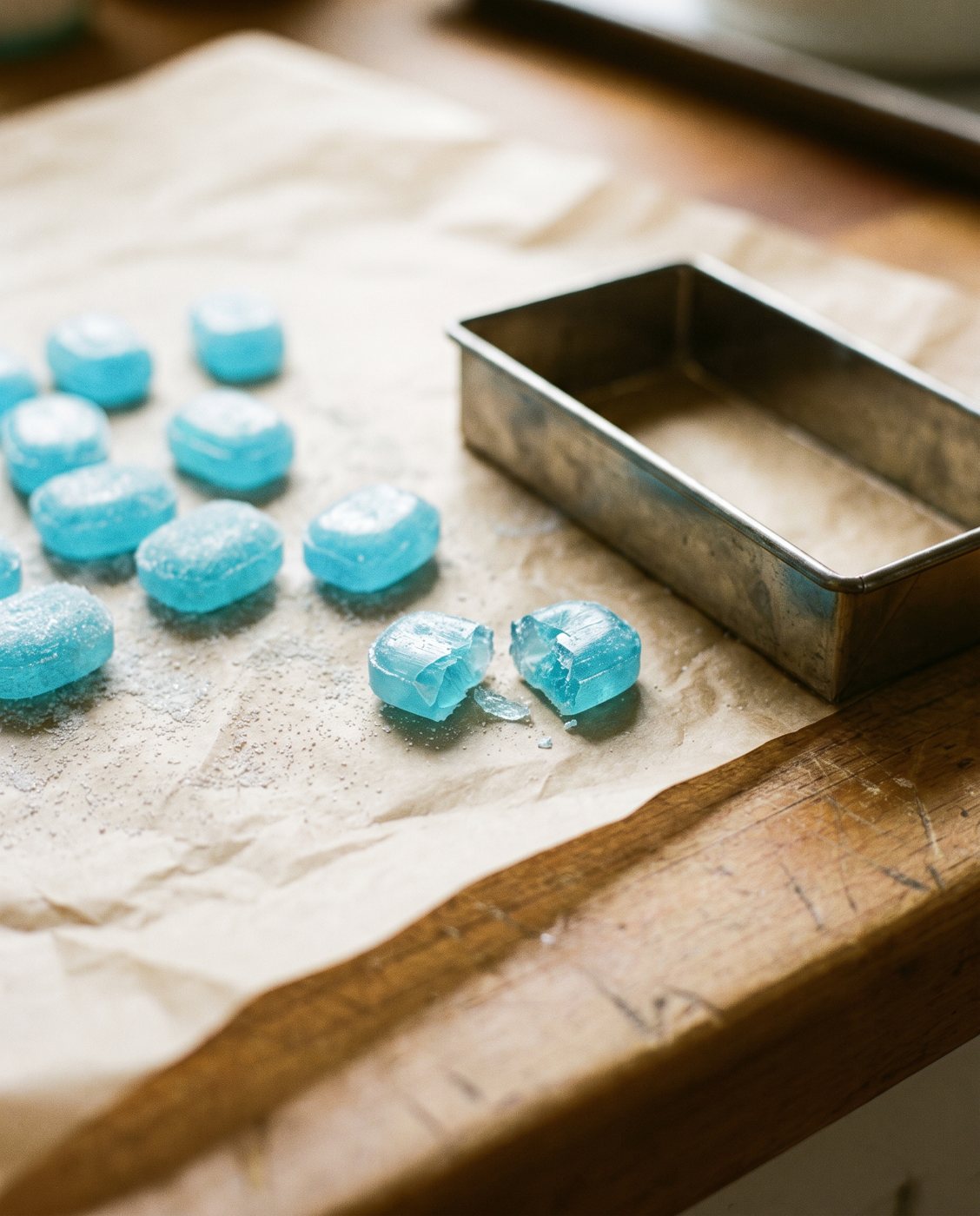
Our two grades are built around that number. TintBlue E18 is at least 24% C-phycocyanin and at least 180 colour units, spray dried onto trehalose, and it is the food and beverage grade: the carrier is what makes it disperse in cold water and flow in a dry blend. TintBlue E40 is at least 60% C-phycocyanin and at least 400 colour units with no carrier, so the certificate describes the active and nothing else, and it delivers the same blue at about a third of the E18 dose. The second number on a certificate, the purity ratio A620/A280, says how much of the protein in the bag is the pigment protein; the article on grades explains what each measures and which one to buy on.
Divide any price by the colour value and you have the price of colour, which is the only number that compares across suppliers. What you pay for in a kilo of phycocyanin does that arithmetic, and the nine questions a supplier should answer on paper is the checklist for the certificate that should come with the bag.
How to use it
Phycocyanin is a protein, so using it well means keeping a protein folded. Four numbers do most of the work.
The dose is 0.05 to 0.30% w/w of finished product for E18, which is 0.5 to 3 g per kilo. Where you land inside that range depends on the matrix, the sweetener system and the depth of blue you want, and those move it by 30 to 60%. For E40 the range is 0.01 to 0.10%.
The pH window is 4.0 to 7.5. Mild acid is on your side: the protein is more stable at pH 5 than at pH 7, as Patel and colleagues measured in their study of thermal denaturation kinetics. Below pH 4.0 it begins to unfold, and below 3.5 the colour goes and no cold store brings it back. A drink at pH 4.0 to 4.5 with the acid buffered on citrate is the reference case; a drink at pH 3.2 is a different ingredient's job. What actually breaks the blue at low pH has the kinetics, and the comparison with Galdieria phycocyanin covers what to do below the window.
The heat limit is a product of temperature and time. Jespersen and colleagues measured the heat and light stability of spirulina blue against two other natural blues in model confectionery and beverage systems, in their study of three natural blue colorants, and the practical outcome is a window rather than a single number. TintBlue loses colour faster above about 60 °C, and it tolerates, with some loss, the short pasteurisation at 72 °C that most beverage lines run. UHT at 135 °C and retort at 121 °C are outside the window by an order of magnitude, and no carrier changes that. The ready to drink article goes through the pasteurisation step minute by minute.
Light is the slow loss. Phycocyanin evolved to collect photons, and in a clear bottle under a shop light that is what it keeps doing, with nowhere to send the energy. The shade that passed every trial in a dark cold room comes back faded from the front row of the shelf. Opaque or UV blocking packaging is part of the formula; the article on light and packaging has the half lives.
The order of operations is the same in every format. Make a 5 to 10% premix in cold deionised water. Add it to the cold aqueous phase, never to a hot line. Hold the pH at or above 4.0 with a buffer rather than free acid. Heat once, briefly. Pack out of the light.
Where it works, and where it needs conditions
Gummies, hard candy, icings, dry mixes, dairy, ice cream and pasteurised drinks all sit inside the window. Each one stresses a different edge of it, and each has its own article with the starting formula.
Gummies are acid, sugar and a hot deposit at once. Pectin beats gelatin for this pigment and the sugar protects the protein, which is why a deposit that would kill the colour in water is survivable in a gummy mass; the starter formula is in phycocyanin in gummies. Powdered drink mixes are the safest place to store the pigment and the hardest place to judge it, because the drink is made in someone else's kitchen with their water, so the dry blends article doses for the glass. Yogurt and ice cream are cold, mildly acid and full of fat and protein, close to the best environment the pigment will see; the dairy article covers fat, pH and storage. Frostings and fillings work when the powder is dissolved first and added after the oven, which is the whole of the frostings article.
Beverages work with conditions attached: pH 4.0 or above, a pasteurisation that is short or low, hot fill and fast cooling, and an opaque or UV blocking pack. A clear PET bottle at pH 3.2 through a 90 °C hold fails on three counts at once, and the fix is to change those three conditions.
If the blue is replacing a synthetic, the article on replacing Brilliant Blue FCF lists what changes in the formula, and the comparison of natural blues puts spirulina next to jagua, gardenia and butterfly pea on the numbers.
What the label says
In the United States, spirulina extract is a colour additive exempt from certification under 21 CFR 73.530, and the ingredient statement can declare it as "spirulina extract color" or "colored with spirulina extract". The US article has the current category list, the state dates and the Federal Register citations, and it is the one to read before a claim goes on the front of the pack.
In the European Union, spirulina extract is a colouring food, a food ingredient outside Regulation (EC) No 1333/2008 on additives, so it has no E number and no list of permitted categories. It is declared by name in the ingredient list, and the producer and the user carry the file that shows the extract is an ingredient and not an additive. The EU article explains the enrichment factor behind that classification and what has to be in the file before launch.
In both markets the label reads "spirulina extract", and in both the classification lives in the documents that travel with the bag.
Where to go from here
The two grades, their specifications, their stability data by condition and their application guides are on the Color line page, and the food and beverage grade is TintBlue E18. The sample is 30 g of E18, which at 0.05 to 0.30% colours 10 to 60 kg of finished product, and it ships with the certificate of analysis for the lot you receive. Most buyers run the shelf trial and settle the label question on the same sample.
Sources
- Eriksen NT. Production of phycocyanin: a pigment with applications in biology, biotechnology, foods and medicine. Appl Microbiol Biotechnol, 2008. 10.1007/s00253-008-1542-y
- Patel A, Pawar R, Mishra S, Sonawane S, Ghosh PK. Kinetic studies on thermal denaturation of C-phycocyanin. Indian J Biochem Biophys, 2004. PubMed 22900283
- Jespersen L, Strømdahl LD, Olsen K, Skibsted LH. Heat and light stability of three natural blue colorants for use in confectionery and beverages. Eur Food Res Technol, 2005. 10.1007/s00217-004-1062-7
The doses, pH window, heat limits and retention figures are ours, from the specifications and application guides for TintBlue E18 and TintBlue E40. The regulatory citations are given in full in the US and EU articles linked above.

