
A phycocyanin quote arrives with a code on it: E6, E18, E25, E40. Buyers treat it as a quality grade, the way a higher number on anything is better. It is not a quality grade. It is a concentration, and the price per kilo means nothing until you know what it is a concentration of.
The colour value: how much blue per gram
The E number is the colour value of the powder. Dissolve 1 g in 100 mL, read the absorbance at 620 nm across a 1 cm path, and divide by 10. E18 means that solution reads 18, which is to say 180 colour units per gram at 1%. E40 reads 400. Absorbance at 620 nm is what the chromophore does, so this is a direct measure of how much blue a gram of powder puts into a litre of product.
Two grades with the same colour value colour the same amount of drink to the same depth. That is the whole use of the number, and it makes the price per kilo comparable across suppliers: divide the price by the colour value and you have the price of colour. An E40 at twice the price of an E18 is the cheaper blue, before you have counted the freight on the carrier you did not buy.
What the colour value does not tell you is what the rest of the gram is.
The purity ratio: how much of the powder is the protein
The second number is the ratio of absorbance at 620 nm to absorbance at 280 nm, written A620/A280. The chromophore absorbs at 620. Every protein in the extract absorbs at 280, because that is where aromatic amino acids absorb. The ratio therefore says how much of the protein present is phycocyanin rather than the rest of the cell.
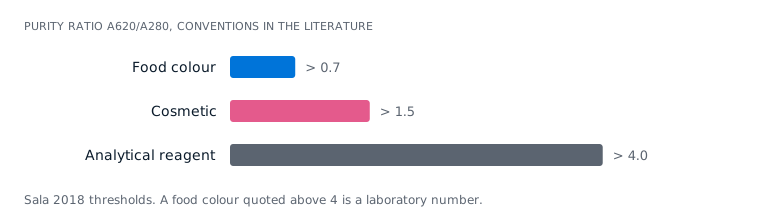
The conventions were set by the purification literature. Sala and colleagues give the thresholds most suppliers quote: above 0.7 for food use, above 1.5 for cosmetics, above 4.0 for therapeutic and analytical work, in their paper on selective extraction at food grade purity. Bhaskar and colleagues, writing earlier, put the food threshold at 2 and the pharmaceutical threshold at 4, in a method for extraction and purification from Spirulina platensis. The two papers do not agree on the food number, which tells you the thresholds are conventions and not regulations. What they agree on is the shape: a crude extract sits below 1, a food colour sits around 1 to 2, and a reagent sits at 4 or above.
Above 4 is a laboratory product. Patel and colleagues reached 4.42 from Spirulina with ammonium sulphate precipitation and ion exchange chromatography, in their purification from marine and freshwater cyanobacteria, and Kong and colleagues reached 4.5 with free flow electrophoresis, in their work on carrier buffer design. Neither is a food process, and neither price is a food price. A supplier quoting a purity ratio above 4 for a colouring food is quoting a number from a different product.
The carrier: where the rest of the gram went
An E18 grade is roughly 24% C-phycocyanin. The other three quarters is mostly carrier, in our case trehalose, and it is there on purpose. The carrier is what makes the powder flow, disperse in cold water and survive on a shelf without caking; it also happens to protect the protein against heat, which is a separate piece and worth reading. An E40 at roughly 60% C-phycocyanin has no carrier at all. The excipient system becomes yours to choose, it doses at about a third of E18, and the powder is hygroscopic and wants resealing the moment it is weighed.
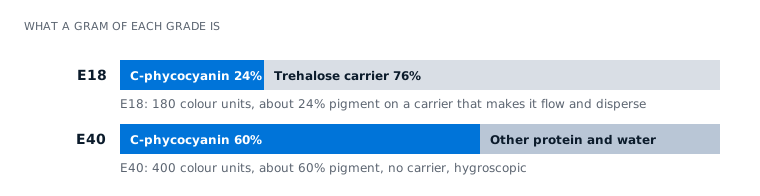
So the grades are not better and worse. They are two answers to the question of who handles the carrier. A beverage plant with a pre-mix step buys E18 and lets the carrier do its work. An encapsulator who has an excipient system already buys E40 and does not pay to ship trehalose.
What "blue spirulina" is
The retail product sold as blue spirulina is the same extract at a low colour value, often E3 to E6, in a small pouch at a high price per gram. It is fine for a smoothie. It is not what a factory buys, and its price per gram says nothing about the price of colour at E18 in 25 kg bags. When somebody compares our price per kilo to a retail listing, they are comparing a bag of colour to a sachet of carrier.
Which number to buy on
Buy colour on the colour value, because that is what you are paying for. Read the purity ratio to check that the colour comes from phycocyanin and not from something else that happens to absorb at 620 nm, which for a spirulina extract it does. And read both off the certificate of analysis for the lot you are receiving, not off the data sheet, because the data sheet is a promise and the certificate is a measurement.
Our food grade is specified at a minimum of 180 colour units and 24% w/w C-phycocyanin. The concentrate is specified at 400 colour units minimum and 60% w/w. The certificate carries both numbers for every lot, and the sample ships with the certificate for the lot you receive, so the comparison above can be run on our material before anyone orders a kilo.
Sources
According to PubMed:
- Sala L, Moraes CC, Kalil SJ. Cell pretreatment with ethylenediaminetetraacetic acid for selective extraction of C-phycocyanin with food grade purity. Biotechnol Prog, 2018. 10.1002/btpr.2713
- Bhaskar SU, Gopalaswamy G, Raghu R. A simple method for efficient extraction and purification of C-phycocyanin from Spirulina platensis Geitler. Indian J Exp Biol, 2005. PubMed 15816417
- Patel A, Mishra S, Pawar R, Ghosh PK. Purification and characterization of C-Phycocyanin from cyanobacterial species of marine and freshwater habitat. Protein Expr Purif, 2005. 10.1016/j.pep.2004.10.028
- Kong FZ, Yang Y, He YC, et al. Design of suitable carrier buffer for free-flow zone electrophoresis by charge-to-mass ratio and band broadening analysis. Electrophoresis, 2016. 10.1002/elps.201600040
The grade specifications are ours, from the data sheets for TintBlue E18 and TintBlue E40.


