
A ready to drink beverage is the largest single use of natural blue and the one with the narrowest process window. The pigment goes into water, the water goes through a heat exchanger, the product goes into a bottle and the bottle goes onto a shelf. Each of those four steps has a number attached, and a launch works when all four are respected in order.
The window, in numbers
Faieta and colleagues held C-phycocyanin at fixed temperatures from 45 to 80 °C and followed the colour. At 45 °C it was stable over the experiment. At 80 °C most of it was gone inside ten minutes. Between the two the loss followed first order kinetics, so it is the product of temperature and time that matters, and they also found that the colour left before the chromophore did, through aggregation of the protein, in their study of isothermal and dynamic thermal degradation.
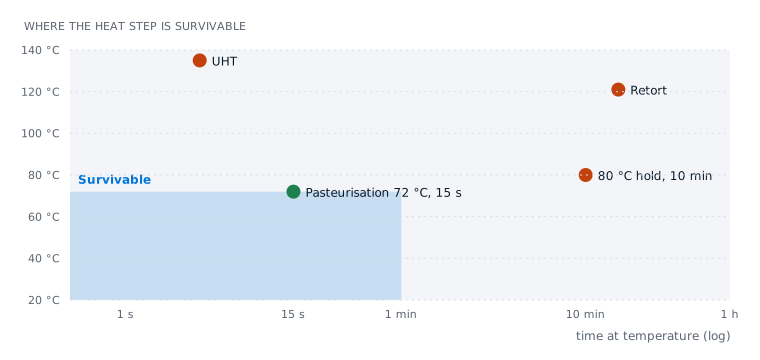
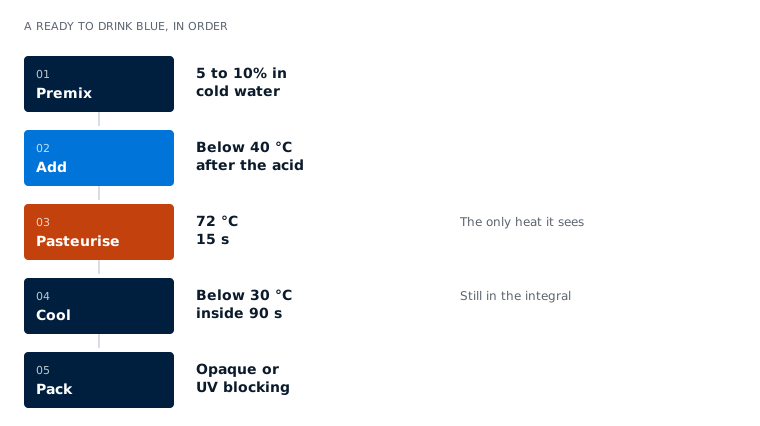
That is the whole reason a flash pasteurisation works and a hold does not. Seventy two degrees for fifteen seconds is a small area under the curve. Eighty degrees for ten minutes is a large one. Our specification is measured against the first: pasteurise at 72 °C for 15 s, hot fill, and cool below 30 °C inside 90 seconds. The cooling is not a footnote. A bottle that sits at 70 °C on a conveyor for four minutes is still in the integral.
UHT at 135 °C and retort at 121 °C are outside the window by an order of magnitude, and no carrier changes that.
Acid is not the enemy, but it sets the floor
A beverage at pH 3.0 to 3.5 is common and it is below where the protein holds. Patel and colleagues measured denaturation kinetics across pH 4.0 to 8.0 and found the protein several times more stable at pH 5 than at 7, in their study of thermal denaturation kinetics, so inside the window mild acid helps. Below pH 3.5 the protein unfolds regardless of temperature. Brauch and colleagues put the half life of spirulina blue in solution at pH 3.6 at 70 days, in their comparison of blue colorants, which is a number to design a short shelf life around and not a long one.
The practical answer for a blue drink is to formulate at pH 4.0 to 4.5 and use the acid system to hold it there rather than to chase a lower number. Citrate buffers well and tastes clean. A sports water at pH 4.5 is the reference formula for our food grade, and its retention is the one we publish: 85% at 12 months ambient in the beverage matrix.
Sugar buys margin, and zero sugar spends it
Faieta and colleagues, in a second paper, showed that sucrose and trehalose in solution slow the thermal loss of phycocyanin in proportion to their concentration, with sucrose the better of the two, and that circular dichroism tracks the protein staying folded, in their work on saccharides and thermal stability. A full sugar drink carries its own stabiliser. A zero sugar version on sweeteners does not, and it will lose more colour through the same heat step. The two are different trials and should be run as such; a shade approved on the full sugar version is not approved on the diet one.
Order of addition
Make a 5 to 10% pre-mix in cold deionised water. Add it to the aqueous phase below 40 °C, after the acid is in and buffered, never into a hot line. Then pasteurise. The pigment sees the heat once, for fifteen seconds, in a matrix that is already at its final pH and sugar content. A pigment dosed into a hot syrup before dilution sees the heat twice and at a higher concentration of acid, and that is where trials fail without anyone changing the recipe.
Clear bottle, clear problem
The shelf is a slower version of the heat step. Under light the protein fades and, in a clear drink, precipitates; the mechanism is described by Wang and colleagues in their work on phycocyanin under UV at beverage pH. Our specification requires opaque or UV blocking packaging, and the retention figures are measured in the dark because that is what such packaging delivers. A clear PET bottle on a lit cooler is a different product with a different shelf life, and it needs its own study under its own lights.
Where encapsulation fits
Where a brief pushes below pH 3.5 or towards a longer hot step, complexing or encapsulating the pigment is the direction of travel. Buecker and colleagues kept pectin phycocyanin complexes in suspension through 85 °C at a pectin ratio of 2.0 or above, in their paper on pectin phycocyanin complexes, and Lemos and colleagues reported improved stability under acid, heat and light with chitosan microparticles, in their paper on chitosan encapsulation. Both are laboratory results. Our carrier free concentrate, TintBlue E40, is the base for that kind of work because it arrives with nothing already on it, and the 88% retention at 12 months we quote for it is measured on encapsulated material at pH 4.5, which is what it can reach in a matrix built for it and not what the bare powder does.
The formula we run
TintBlue E18 at 1.2 g per litre, 0.12% w/w, pH 4.5, citrate buffered, in a sugared sports water. Pre-dispersed cold, added below 40 °C, pasteurised at 72 °C for 15 s, hot filled, cooled below 30 °C inside 90 s, packed opaque. Predicted retention 85% at 12 months ambient. Every one of those conditions is printed beside the number on the data sheet, and a 30 g sample colours 10 to 60 kg of finished product at those levels, which is enough to run the trial on your own line rather than take ours on trust.
Sources
According to PubMed:
- Faieta M, Toong C, Corradini MG, Ludescher RD, Pittia P. Degradation kinetics of C-Phycocyanin under isothermal and dynamic thermal treatments. Food Chem, 2022. 10.1016/j.foodchem.2022.132266
- Patel A, Pawar R, Mishra S, Sonawane S, Ghosh PK. Kinetic studies on thermal denaturation of C-phycocyanin. Indian J Biochem Biophys, 2004. PubMed 22900283
- Brauch JE, Zapata-Porras SP, Buchweitz M, Aschoff JK, Carle R. Jagua blue derived from Genipa americana L. fruit: a natural alternative to commonly used blue food colorants? Food Res Int, 2016. 10.1016/j.foodres.2016.08.029
- Faieta M, Neri L, Sacchetti G, Di Michele A, Pittia P. Role of saccharides on thermal stability of phycocyanin in aqueous solutions. Food Res Int, 2020. 10.1016/j.foodres.2020.109093
- Wang Y, Zhu Y, Li Y, Wang S. Mechanistic insights into transglutaminase-mediated self-crosslinking of C-phycocyanin: structural reinforcement underlying enhanced UV-light stability in acidic conditions. Int J Biol Macromol, 2026. 10.1016/j.ijbiomac.2026.150852
- Buecker S, Gibis M, Bartmann L, Bussler S, Weiss J. Improving the colloidal stability of pectin-phycocyanin complexes by increasing the mixing ratio. J Food Sci, 2024. 10.1111/1750-3841.16917
- Lemos PVF, Veríssimo NVP, Teixeira JB, Marcelino HR, Ferreira GA, Souza CO. Encapsulation of C-phycocyanin in chitosan microparticles improves thermal and storage stability for use as a natural food colorant. Food Chem, 2025. 10.1016/j.foodchem.2025.147358
The process conditions and the reference formula are from the application guide for TintBlue E18; the encapsulated retention figure is from TintBlue E40.

