
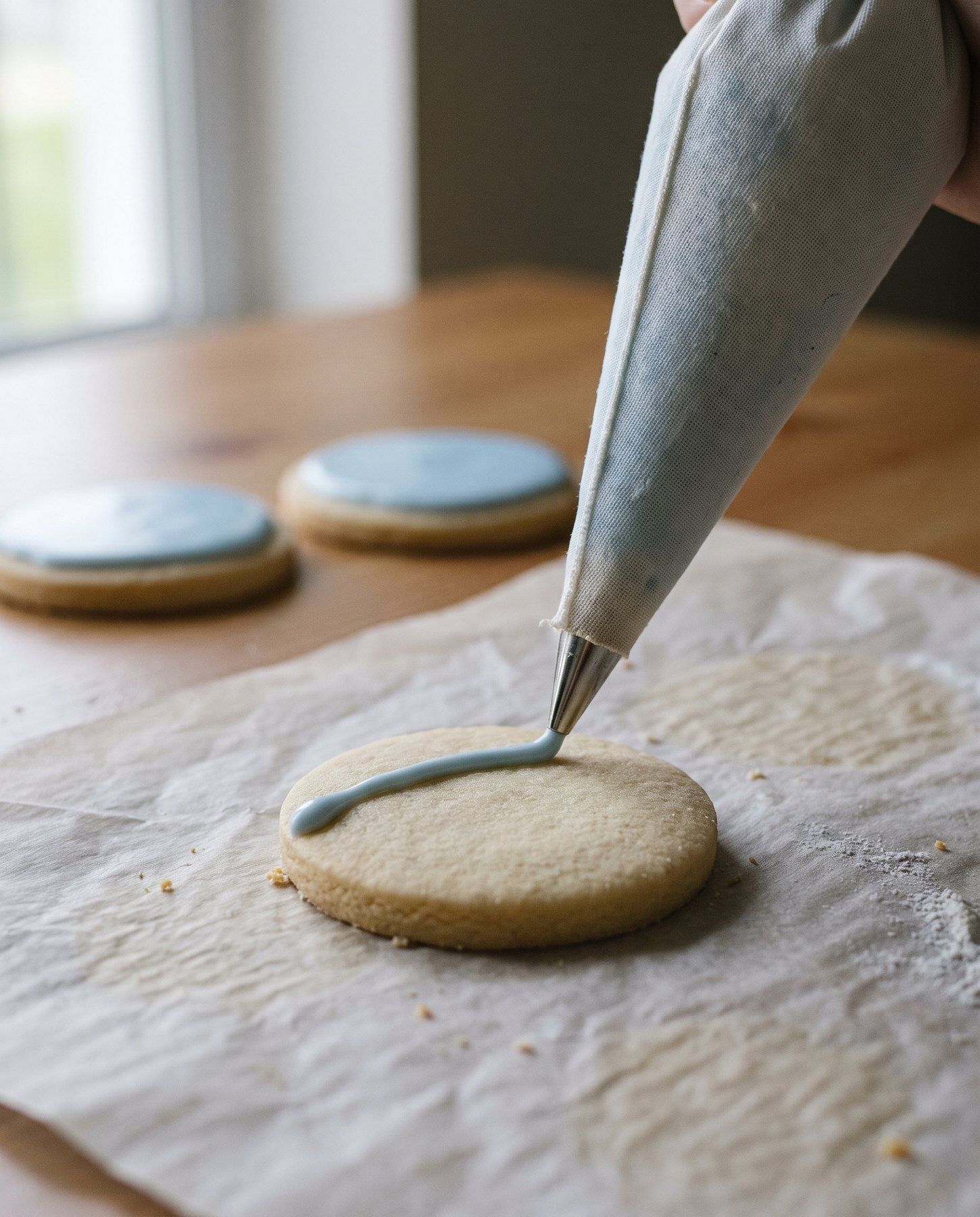
A frosting is close to the easiest place to put phycocyanin. It is mostly sugar with very little free water, and it is made cold, after the bake. The pigment never has to see the oven unless someone asks it to.
When a blue frosting fails, it is usually for one of three reasons. The powder never dissolved, the base sat outside the pH window, or the colour went into something that was baked afterwards. Each one is avoidable on the bench.
The sugar is on your side
Faieta and colleagues heated spirulina extract in water and in sucrose and trehalose solutions of rising concentration. Colour loss went up with time and down with sugar concentration, sucrose protected better than trehalose, and the activation energy of the colour loss tracked the water activity of the solution, in their work on saccharides and phycocyanin. A frosting is that experiment pushed to the end: a sugar matrix with almost no water left to move.
Huo and colleagues tested glucose, mannose, galactose, maltose, mannitol and maltitol. Glucose, mannose, mannitol, galactose and maltose improved the thermal stability of food grade C-phycocyanin, the effect rose with concentration, and it dropped sharply above 60 °C, in their study of saccharides and sugar alcohols. For a reduced sugar frosting, mannitol is the polyol with data behind it in that study. Maltitol was tested and is not among the ones the abstract lists as effective, so a maltitol frosting needs its own shelf trial.
Dissolve it in the water phase first
Phycocyanin dissolves in water and not in fat. A buttercream is mostly fat and sugar with a few percent of milk or water. Stir the dry powder into whipped butter and it stays as dark specks until it finds water.
Dissolve the colour in the liquid part of the recipe first, at 5 to 10% in cold water or milk, and add that premix to the base. TintBlue E18 is spray dried on a trehalose carrier and disperses in cold water, so it goes into the premix without lumps. TintBlue E40 has no carrier and is hygroscopic: weigh it, close the bag straight away, and give it a minute of stirring in the premix. A fat continuous coating such as a compound coating or a candy melt has no water phase to dissolve into, and it is not where we would start with this pigment.
Fat makes the same dose read lighter
Fat globules scatter light, and a blue in a fatty base reads paler than the same dose in a fat free one. The pigment is all still there; it is optics. We cover it with swatches in the dairy and ice cream article. For frostings it means the same dose gives a deeper blue in royal icing, which has no fat, than in buttercream. Match the shade in the base that ships, at its real fat content, and expect a buttercream to need more colour than an icing.

Royal icing: check the egg white before the colour
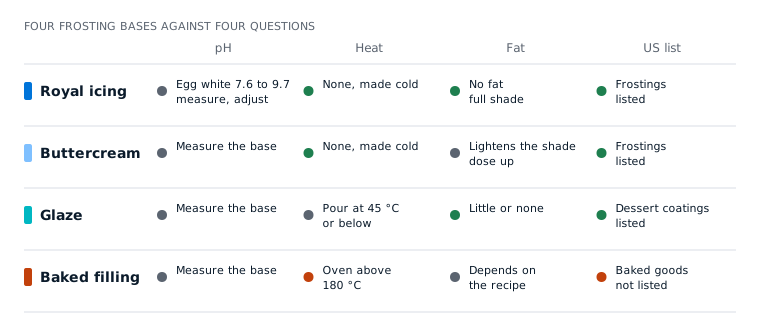
Royal icing is made on egg white or meringue powder, and egg white is alkaline. Banerjee and colleagues give the pH of a newly laid egg's white as 7.6 to 8.5, rising to 9.7 in storage as the carbon dioxide leaves, in their paper on carbon dioxide and egg white lysozyme. TintBlue E18 is specified from pH 4.0 to 7.5 and E40 from 4.5 to 7.5. An icing on older egg white can start above the top of that window.
Measure the pH of the base before the colour goes in. If it reads above 7.5, a small addition of acid, such as cream of tartar or citric acid, brings it down; measure again after mixing. Our reference royal icing runs TintBlue E18 at 0.15 g per 100 g, 0.15% w/w, as a surface decoration on a cooled bake.
The oven is where it stops
Oven heat above 180 °C degrades the pigment, so the colour goes on after the bake. Faieta and colleagues held C-phycocyanin at fixed temperatures and found it stable at 45 °C over the experiment and mostly gone inside ten minutes at 80 °C, in their study of isothermal and dynamic thermal degradation. A glaze poured over a bake that is still warm is a heat step. Let the bake cool to 45 °C or below before the glaze goes on.
The same line decides fillings. A cream filling piped or injected after the bake is a frosting by another name. A filling baked inside the dough goes through the oven, and we would not put this pigment in one.
Where the US list draws the line
In the US, spirulina extract is a colour additive exempt from certification under 21 CFR 73.530, and paragraph (c) names frostings, confections, and dessert coatings and toppings among its permitted uses. It does not name baked goods or bakery fillings. A blue frosting on a cookie is covered; a blue filling baked into a pastry is not on the list. An unbaked cream filling is not named either, so check with regulatory counsel which listed category your product falls under before launch. The state of the US list, including the expansion that is on hold, is in our article on the FDA dye phase-out. In the EU the question is different and is covered in the colouring food article.
Storage: cool, and out of the light
Gunes and colleagues coloured a toffee type soft candy with a phycocyanin powder sold as E18 grade by another supplier, added at 50 to 55 °C while the mass was kneaded, at 0.1 to 0.5%. At 0.5% the blue was strong enough. Wrapped in metallised film and stored for three months, the colour difference ΔE stayed between 0.14 and 0.44 at 4 °C, 0.84 and 2.76 at 20 °C, and 2.63 and 7.90 at 40 °C, in their study of phycocyanin in soft candy. That candy is a different product from a frosting, with the same sugar, low water and a pigment added warm, and the temperature ranking is the part that carries over.
Light is the other risk. Brauch and colleagues measured a half life of about four days for spirulina blue in clear gelatin gels under light, in their comparison of blue colorants. A cake under a clear dome on a lit bakery counter is that test. Pack opaque, or plan the display time around it; our light and packaging article has the numbers.
When it goes wrong
| What you see | Likely cause | What to change |
|---|---|---|
| Dark specks in buttercream | Powder added dry to the fat | Dissolve in the milk or water first, 5 to 10% premix |
| Shade paler than the lab match | Higher fat in the production base | Match at shipping fat content, dose up |
| Icing fades faster than the shelf test predicted | Base above pH 7.5, outside the specified range | Measure, acidify, measure again |
| Glaze loses colour on the line | Glaze poured on a warm bake | Cool the bake to 45 °C or below |
| Fading on display | Clear packaging under shop lights | Opaque pack, or shorter display time |
Starting doses
These are bench starting points from the use levels on the data sheets, with E40 at about one third of the E18 dose. The royal icing line is our reference formula; the others are where we would start a trial.
| Base | TintBlue E18 | TintBlue E40 | Where it goes in |
|---|---|---|---|
| Royal icing | 0.15% w/w (reference) | about 0.05% | Dissolved in the water or egg white, before the sugar |
| Buttercream | 0.15 to 0.22% | 0.05 to 0.07% | In the milk or water, then into the beaten butter |
| Glaze on a cooled bake | 0.10 to 0.15% | 0.03 to 0.05% | In the water, glaze at 45 °C or below |
| Cream filling, piped after the bake | 0.10 to 0.20% | 0.03 to 0.07% | In the water phase |
Which grade does which job
E18 is the one to weigh at bakery scale. At 0.15%, a 10 kg batch of icing takes 15 g, a quantity a production scale reads without fuss, and the carrier disperses it in cold water. E40 goes in at about one third of the E18 dose, so the same blue takes a third of the weight and dissolves in less liquid. That matters in a buttercream whose recipe has very little milk to dissolve the colour in. E40 is specified from pH 4.5, so it is the one to check twice in an acidified base.
Our free 30 g sample of TintBlue E18 colours 20 kg of royal icing at 0.15%. The 10 g sample of TintBlue E40 colours about 20 kg at 0.05%. Either is enough for a full bench trial and a shelf test. Request a sample, and if you are coming from a synthetic blue, the Brilliant Blue replacement guide covers what changes in the label.
Sources
According to PubMed and the regulatory record:
- Faieta M, Neri L, Sacchetti G, Di Michele A, Pittia P. Role of saccharides on thermal stability of phycocyanin in aqueous solutions. Food Res Int, 2020. 10.1016/j.foodres.2020.109093
- Huo Y, Hou X, Yu Y, Wen X, Ding Y, Li Y, Wang Z. Improving the thermal and oxidative stability of food-grade phycocyanin from Arthrospira platensis by addition of saccharides and sugar alcohols. Foods, 2022. 10.3390/foods11121752
- Banerjee P, Keener KM, Lukito VD. Influence of carbon dioxide on the activity of chicken egg white lysozyme. Poult Sci, 2011. 10.3382/ps.2010-00854
- Faieta M, Toong C, Corradini MG, Ludescher RD, Pittia P. Degradation kinetics of C-Phycocyanin under isothermal and dynamic thermal treatments. Food Chem, 2022. 10.1016/j.foodchem.2022.132266
- Gunes R, Palabiyik I, Kurultay S. A preliminary study on the use of phycocyanin as a natural blue color source in toffee-type soft candy: effect of storage temperature and pigment concentration. Food Sci Nutr, 2024. 10.1002/fsn3.4401
- Brauch JE, Zapata-Porras SP, Buchweitz M, Aschoff JK, Carle R. Jagua blue derived from Genipa americana L. fruit: a natural alternative to commonly used blue food colorants? Food Res Int, 2016. 10.1016/j.foodres.2016.08.029
- 21 CFR 73.530, Spirulina extract, paragraph (c), as in force on 1 October 2026. eCFR
The royal icing reference, the oven limit, the pH ranges and the use levels are from the data sheets for TintBlue E18 and TintBlue E40.

