
Spirulina extract, which is what we sell, and galdieria extract blue carry the same pigment. Both are C-phycocyanin: a protein holding a linear chromophore, phycocyanobilin, in the shape that makes it blue. When the FDA listed galdieria extract blue in May 2025, the order recorded the petitioner's position that the C-phycocyanins of Galdieria sulphuraria and Arthrospira platensis belong to the same family, and the 90 day study behind the listing ran spirulina phycocyanin alongside it as the reference.
Same family, different protein. One of them holds its blue at pH 3. The other does not, and that is the whole reason this comparison comes up in sales calls.
Where the two organisms live
Galdieria belongs to the Cyanidiophyceae, a group of red algae that are the only photosynthetic eukaryotes able to live in hot springs at pH 0 to 5 and 35 to 63 °C. Spirulina is a cyanobacterium, not one of them. Whether the phycocyanin inherited the toughness is a question the data answers directly.
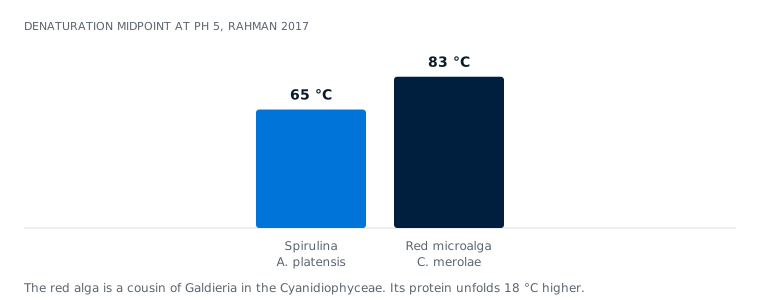
The clearest measurement comes from a close relative. Rahman and colleagues extracted phycocyanin from Cyanidioschyzon merolae, another member of the Cyanidiophyceae, and compared it with spirulina phycocyanin. At pH 5 the denaturation midpoint was 83 °C for the red alga and 65 °C for spirulina, and the red alga's protein stayed relatively stable at pH 4 and 5 up to 80 °C.
The structural reason has been worked out on another sister species. Ferraro and colleagues solved the crystal structure of phycocyanin from Galdieria phlegrea and compared it with other phycocyanins, including re-refined models of the G. sulphuraria protein. The G. phlegrea protein has more salt bridges holding its trimers together, and the authors trace them to small side chain shifts rather than to extra charged residues. The same group showed in a biophysical characterisation that this protein is stable across different pH values and unfolds only above 80 °C between pH 5.0 and 7.0.
Two cautions belong here. The structural work is on G. phlegrea, and the melting point comparison is on C. merolae. Both are relatives of the species being sold, not the species itself.
What the data on the commercial extract shows
The best public data on G. sulphuraria phycocyanin as an ingredient is in the EFSA opinion on blue galdieria extract, published in March 2026. EFSA summarised the applicant's stability work, run against spirulina extracts on colour retention at 618 nm.
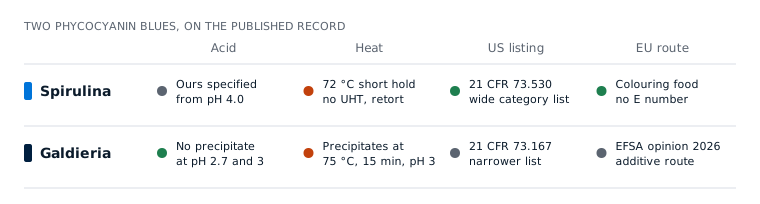
The acid result is the one that matters. Solutions of the unformulated extract, with no carrier or stabiliser, were held at pH 2.7 and pH 3. The spectra showed the lower pH made little difference to the protein, and there was no precipitation at either.
Heat still breaks it. At pH 3 for 15 minutes, precipitation went from minimal at 55 °C to significant at 75 °C, and the blue faded with it. EFSA's reading of the spectra is that the protein unfolds and lets the chromophore fold out of its blue form; the chromophore itself was recovered intact. Glucose at 20% reduced the loss at 60 and 80 °C. Light remained a problem: colour was lost after 24 to 36 hours of high intensity exposure.
So the honest summary is narrow. Galdieria phycocyanin survives acid that spirulina phycocyanin does not. Heat at pH 3 still precipitates it, so the process window question does not go away, and it fades in light like every phycocyanin.
Why spirulina phycocyanin struggles in the same glass
Spirulina phycocyanin is not fragile in mild acid. Patel and colleagues found it about five times more stable at pH 5.0 than at pH 7.0 at 65 °C, in their study of denaturation kinetics, and we cover that in detail in our article on low pH.
The trouble starts lower. Buecker and colleagues, working with a colouring foods company, put the practical problem plainly in their study of pectin complexes: under the acidic conditions of soft drinks and hard candy, spirulina phycocyanin tends to agglomerate and lose its colour, and heating speeds the process. Brauch and colleagues measured a half life of 70 days for spirulina blue in solution at pH 3.6, in their comparison with synthetic references. That is a usable number for some products and a short one for a soft drink meant to sit in a warehouse.
This is why our own specification for TintBlue E18 runs from pH 4.0 to 7.5 and says to keep the product above pH 3.5 at all times. We do not sell it into a pH 3 drink, and we would rather say so here than in a failed trial.
What it means on the label
The two blues are regulated as different things on both sides of the Atlantic.
In the United States, spirulina extract is listed under 21 CFR 73.530 for a long list of categories that includes non-alcoholic beverages, and galdieria extract blue under 21 CFR 73.167 for a shorter one: non-alcoholic beverages and fruit drinks, dairy drinks, cereal coatings, candy and gum, frostings, frozen desserts, gelatin, puddings, yogurt, creamers and toppings. Both are exempt from certification. Our article on the US dye phase-out covers the spirulina list and its suspended expansion.
In the European Union, spirulina extract is sold as a colouring food, with no E number, as set out in our article on the EU framework. Blue galdieria extract is going the other way, through the food additive route. EFSA found no safety concern at the proposed uses and set an acceptable daily intake of 7 mg C-phycocyanin per kg body weight. An EFSA opinion is a scientific step, not an authorisation; the additive becomes usable when the Commission lists it in Annex II of Regulation 1333/2008, with its conditions of use. Check that listing before planning a European launch on it.
How to choose today
Start with the pH of the finished product, measured, not the target on the brief.
At pH 4.0 and above, with a pasteurisation step at 72 °C for a short hold or none at all, spirulina extract does the job. It has the wider US category list, it needs no additive authorisation in Europe, and it has been listed in the United States since 2013, against 2025 for galdieria. That is the range TintBlue is specified for.
Between pH 3.5 and 4.0, spirulina extract can work, and the result depends on the formula. Sugar helps: Faieta and colleagues found that heated phycocyanin lost less colour as sucrose or trehalose concentration went up, with sucrose doing better, in their work on saccharides, so a full sugar drink is easier than its zero sugar version. Pectin at a ratio of at least 2.0 to phycocyanin kept heated complexes in suspension in the Buecker study. Run the trial at the real pH, through the real heat step, and hold it at the real storage temperature.
Below pH 3.5, spirulina phycocyanin is the wrong tool and we will tell you so. That is where galdieria extract blue has data behind it. Ask its supplier for retention in a matrix like yours, at your pH, after your heat step, over the shelf life you need. The EFSA summary shows what such data looks like and where it stops: it covers precipitation and spectra, and does not give a twelve month retention figure in a finished drink.
Whatever the source, pack it opaque. Light fades both.
If your product sits at pH 4.0 or above, the 30 g sample of TintBlue E18 colours 10 to 60 kg of finished product, and the certificate of analysis for the lot comes with it. If it sits below 3.5, send us the formula anyway and we will say plainly whether spirulina will hold. What the molecule does under other conditions is collected on the phycocyanin page.
Sources
According to PubMed and the regulatory record:
- Van Etten J, Cho CH, Yoon HS, Bhattacharya D. Extremophilic red algae as models for understanding adaptation to hostile environments and the evolution of eukaryotic life on the early earth. Semin Cell Dev Biol, 2023. 10.1016/j.semcdb.2022.03.007
- Rahman DY, Sarian FD, van Wijk A, Martinez-Garcia M, van der Maarel MJEC. Thermostable phycocyanin from the red microalga Cyanidioschyzon merolae, a new natural blue food colorant. J Appl Phycol, 2017. 10.1007/s10811-016-1007-0
- Ferraro G, Imbimbo P, Marseglia A, Lucignano R, Monti DM, Merlino A. X-ray structure of C-phycocyanin from Galdieria phlegrea: determinants of thermostability and comparison with a C-phycocyanin in the entire phycobilisome. Biochim Biophys Acta Bioenerg, 2020. 10.1016/j.bbabio.2020.148236
- Ferraro G, Imbimbo P, Marseglia A, et al. A thermophilic C-phycocyanin with unprecedented biophysical and biochemical properties. Int J Biol Macromol, 2020. 10.1016/j.ijbiomac.2020.02.045
- EFSA Panel on Food Additives and Flavourings. Safety evaluation of blue galdieria extract as a food additive. EFSA Journal, 2026. 10.2903/j.efsa.2026.9960
- Patel A, Pawar R, Mishra S, Sonawane S, Ghosh PK. Kinetic studies on thermal denaturation of C-phycocyanin. Indian J Biochem Biophys, 2004. PubMed 22900283
- Buecker S, Gibis M, Bartmann L, Bussler S, Weiss J. Improving the colloidal stability of pectin-phycocyanin complexes by increasing the mixing ratio. J Food Sci, 2024. 10.1111/1750-3841.16917
- Brauch JE, Zapata-Porras SP, Buchweitz M, Aschoff JK, Carle R. Jagua blue derived from Genipa americana L. fruit: a natural alternative to commonly used blue food colorants? Food Res Int, 2016. 10.1016/j.foodres.2016.08.029
- Faieta M, Neri L, Sacchetti G, Di Michele A, Pittia P. Role of saccharides on thermal stability of phycocyanin in aqueous solutions. Food Res Int, 2020. 10.1016/j.foodres.2020.109093
- FDA. Listing of color additives exempt from certification; galdieria extract blue. 90 FR 20104, 12 May 2025
The pH range, the 3.5 floor and the sample yield are from our own specification for TintBlue E18, printed with their conditions on the product page.

