
A beverage passes its pasteurisation trial, sits in the pilot cold room for three months looking perfect, ships, and comes back from a supermarket with the colour gone from the front row and intact at the back. Nothing changed in the formula. The front row was under the lights.
Phycocyanin is a light harvesting protein. Collecting photons is what it evolved to do, and outside the cell there is nothing to hand the energy on to, so the energy goes into the protein instead. The chromophore isomerises, the protein unfolds around it, and both the colour and the solubility go. This is the loss mechanism a shelf life study at ambient temperature in the dark will never find.
How fast it goes
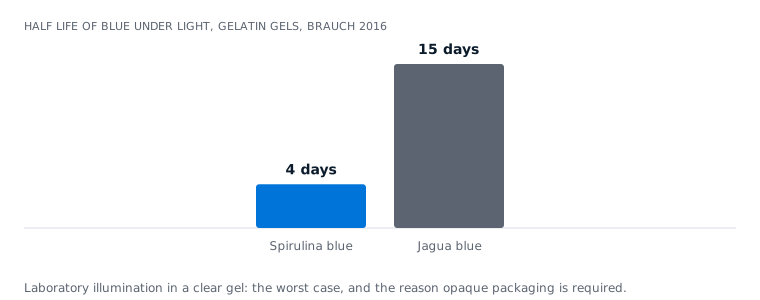
The cleanest comparison in the literature is from Brauch and colleagues, who put spirulina blue and a jagua blue into gelatin gels and left them under light. The spirulina gels lost their blue with a half life of 4 days, against 15 days for jagua, in their assessment of blue colorants against synthetic references. Four days is under laboratory illumination in a clear gel, so it is a worst case, but it is the right order of magnitude for a clear pack under retail lighting and it is far faster than the thermal loss at ambient.
The mechanism is now reasonably well described. Wang and colleagues, working on a beverage model at pH 3.0 under ultraviolet light, describe the failure as rapid colour fading and precipitation under illumination, with the protein losing the structure that holds the chromophore in its coloured state, in their work on cross-linked phycocyanin under UV. The precipitation is the part to note. In a clear drink the colour does not only fade, it comes out of solution, and a haze at the bottom of a bottle fails on the shelf before the shade does.
Light also does damage before the product exists. Trubetskaya and colleagues looked at ultraviolet exposure during extraction and found the pigment sensitive to it at that stage too, with water as the solvent and 45 °C as the ceiling that preserved it, in their study of UV during microwave assisted extraction. An extract that has seen too much light before it was dried arrives with less margin, which is one of the things a colour value on the certificate of analysis catches.
The packaging is the fix
The honest answer to photodegradation is to keep the light off the product. Our specification says it in one line: UV sensitive, opaque packaging required. Not recommended, required. An opaque bottle, a sleeve, a carton, an amber PET that cuts the ultraviolet end, all of these turn a four day problem into a non problem, and none of them cost what a reformulation costs.
Where the brief insists on a clear pack, the shelf life has to be set against the light the pack will actually see, and the study has to include it. A stability protocol that holds samples in a dark incubator is testing heat, and heat is not what takes the colour off a front facing shelf.
The two levers inside the formula
If the pack cannot be changed, two things in the formula move the number.
Complexation and encapsulation. Binding the protein to something protects the chromophore. Zhang and colleagues screened partners and found that bovine serum albumin, sugar alcohols and oligosaccharides bound to phycocyanin improved its colour stability under heat and light across neutral, alkaline and acidic conditions, in their study of protective effects on colour stability. Lemos and colleagues encapsulated phycocyanin in spray dried chitosan microparticles and reported reduced colour loss and turbidity under light and dark storage and under acid and heat, in their paper on chitosan encapsulation. Both are laboratory results rather than products, and both add cost and mass to the formula. They are worth knowing about because they are where the next grade will come from, and because a supplier who claims light stability should be asked which of these they did.
Sugar. A full sugar formula protects the protein against heat, and the same binding that raises the thermal stability helps under light. Faieta and colleagues measured the thermal effect in their work on saccharides and phycocyanin, and the sugar alcohol result above is the same lever seen from the other side. A zero sugar clear drink is therefore the single hardest case for this pigment, and it should be the first thing trialled, not the last.
What to do with this
Put the product in the pack it will ship in and put that pack under the light it will sit under. Read colour and haze, not only colour. If the pack is opaque, light drops off the list and the study can go back to heat and time. If it is clear, set the shelf life against the front row of the shelf, and tell the brand the number before they print it.
The retention figures we publish for TintBlue E18 are measured in the dark, because that is what an opaque pack delivers, and the packaging requirement is printed beside them so nobody reads one without the other.
Sources
According to PubMed:
- Brauch JE, Zapata-Porras SP, Buchweitz M, Aschoff JK, Carle R. Jagua blue derived from Genipa americana L. fruit: a natural alternative to commonly used blue food colorants? Food Res Int, 2016. 10.1016/j.foodres.2016.08.029
- Wang Y, Zhu Y, Li Y, Wang S. Mechanistic insights into transglutaminase-mediated self-crosslinking of C-phycocyanin: structural reinforcement underlying enhanced UV-light stability in acidic conditions. Int J Biol Macromol, 2026. 10.1016/j.ijbiomac.2026.150852
- Trubetskaya A, Haseneder R, Lippold M, van Haren RJF, Herdegen V, Ditscherlein L. The effect of ultraviolet light irradiation on pigment performance in microwave-assisted extraction. Mar Drugs, 2025. 10.3390/md23100391
- Zhang X, Li X, Zhang W, Li Y, Wu B, Cheng H. Investigation on the protective effects of the color stability of phycocyanin in vitro. Food Chem X, 2025. 10.1016/j.fochx.2025.103218
- Lemos PVF, Veríssimo NVP, Teixeira JB, Marcelino HR, Ferreira GA, Souza CO. Encapsulation of C-phycocyanin in chitosan microparticles improves thermal and storage stability for use as a natural food colorant. Food Chem, 2025. 10.1016/j.foodchem.2025.147358
- Faieta M, Neri L, Sacchetti G, Di Michele A, Pittia P. Role of saccharides on thermal stability of phycocyanin in aqueous solutions. Food Res Int, 2020. 10.1016/j.foodres.2020.109093
The packaging requirement and the retention figures are from our own specification for TintBlue E18, and the cosmetic grade carries the same line on Lumia.

