
Brilliant Blue FCF is a good dye. It dissolves in anything, holds its shade through retort, costs almost nothing per litre and never fades on a shelf. Brands are not taking it off the label because it failed. They are taking it off because the label is what the customer reads.
The pressure has a date. In 2007 a randomised, double blind, placebo controlled trial at Southampton gave 297 children drinks containing mixes of artificial colours with sodium benzoate, and measured hyperactivity against placebo. The mixes raised the aggregate score in both age groups, with effect sizes of 0.20 in 3 year olds and 0.12 to 0.17 in 8 and 9 year olds. The trial is in the Lancet paper on food additives and hyperactive behaviour. Brilliant Blue was not one of the six colours in those mixes, and the trial says nothing about it. What it did was put a warning sentence on European labels for the six that were, and from that point every synthetic colour on a children's product became a question at the shelf, whether or not it had been in the study.
So the swap is a labelling decision. The rest of this piece is about what the decision does to the formula, because that part is technical and the people selling spirulina extract tend to skip it.
The dose is not in the same units
E133 is a small synthetic molecule with a very high extinction coefficient. A few parts per million colour a litre of drink. Phycocyanin is a protein of around 110 kDa carrying a chromophore, and the extract a formulator buys is that protein on a carrier at 18 to 40 colour units. Our food grade goes in at 0.05 to 0.30% w/w, which is grams per litre rather than milligrams. A sports drink at 1.2 g per litre is a typical starting point.
Two things follow. The cost per litre is a different calculation, and it has to be run on colour units delivered rather than on price per kilo, which is why we publish the colour value with the price. And the protein brings mass to the formula: a gram of extract per litre is a gram of solids that E133 never added, which matters in a clear water and does not matter in a smoothie.
The shade is not the same blue
Brilliant Blue FCF is a greenish blue, closer to turquoise. Phycocyanin is a cleaner sky blue with less green in it. Put them side by side at matched strength and the difference is obvious; put a phycocyanin drink next to the E133 version it replaced and the customer will say it looks different, because it does.
Matching a turquoise takes a small addition of a natural yellow, typically curcumin or safflower, and that blend is its own stability problem because the two components fade at different rates. If the brief allows the shade to move, let it move. A clean blue reads as natural on a label, which is usually the point of the exercise.
The process window closes at 72 °C
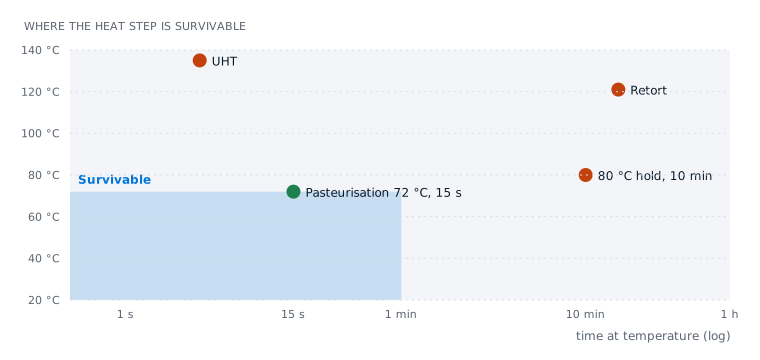
This is where most reformulations stall. E133 does not care about pasteurisation, UHT or retort. Phycocyanin is a protein, and it unfolds when it gets hot. Pasteurisation at 72 °C for a short hold is survivable, and our retention figures are measured against it. UHT and retort are not, and no carrier or encapsulation we have seen changes that at production scale.
Acid is less of a problem than people assume. Patel and colleagues measured the denaturation kinetics of C-phycocyanin across pH 4.0 to 8.0 and found the protein roughly five times more stable at pH 5.0 than at pH 7.0 at 65 °C, in their study of thermal denaturation kinetics. Our specification runs from pH 4.0 and holds above pH 3.5. Below that the protein comes apart. Brauch and colleagues tracked spirulina blue in solution at pH 3.6 and measured a half life of 70 days, which is the number to plan a low pH beverage around, in their comparison of blue colorants against Brilliant Blue and indigo carmine.
Sugar helps, and most drinks have it. Faieta and colleagues showed that sucrose and trehalose in solution raise the thermal stability of phycocyanin in proportion to their concentration, with sucrose performing better, in their work on saccharides and thermal stability. A full sugar formula is therefore easier to colour than its zero sugar sibling, and the two should be trialled separately.
Acid and heat together is the case to test first
A hard candy or an acidified drink that goes through a hot step is the hardest case, because heat in acid makes the protein aggregate and precipitate rather than simply fade. Buecker and colleagues, working with a colouring foods company, showed that complexing phycocyanin with pectin at a pectin to phycocyanin ratio of at least 2.0 kept the complexes colloidally stable after heating to 85 °C, while lower ratios precipitated, in their paper on pectin phycocyanin complexes. That is a formulation lever, and it is one reason a pectin gummy is easier than a gelatin one.
The label is the easy part
In the European Union, spirulina extract is a colouring food, an ingredient outside the additives Regulation 1333/2008. It carries no E number and no warning sentence. In the United States it is spirulina extract under 21 CFR 73.530, exempt from certification. Ingredient line: spirulina extract. That is the whole reason to do this, and it is the only step that is simpler than it was.
What to do with this
Run the trial on colour units, not on grams. Fix the pH where the product needs it and above 3.5. Test the hot step you actually run, at the time it actually takes, and test the zero sugar version on its own. If the brief is a turquoise, price the yellow and its stability into the project before promising a shade. And take a sample before any of it: 30 g of E18 colours 10 to 60 kg of finished product, which is enough to run all of the above.
Sources
According to PubMed:
- McCann D, Barrett A, Cooper A, et al. Food additives and hyperactive behaviour in 3-year-old and 8/9-year-old children in the community: a randomised, double-blinded, placebo-controlled trial. Lancet, 2007. 10.1016/S0140-6736(07)61306-3
- Patel A, Pawar R, Mishra S, Sonawane S, Ghosh PK. Kinetic studies on thermal denaturation of C-phycocyanin. Indian J Biochem Biophys, 2004. PubMed 22900283
- Brauch JE, Zapata-Porras SP, Buchweitz M, Aschoff JK, Carle R. Jagua blue derived from Genipa americana L. fruit: a natural alternative to commonly used blue food colorants? Food Res Int, 2016. 10.1016/j.foodres.2016.08.029
- Faieta M, Neri L, Sacchetti G, Di Michele A, Pittia P. Role of saccharides on thermal stability of phycocyanin in aqueous solutions. Food Res Int, 2020. 10.1016/j.foodres.2020.109093
- Buecker S, Gibis M, Bartmann L, Bussler S, Weiss J. Improving the colloidal stability of pectin-phycocyanin complexes by increasing the mixing ratio. J Food Sci, 2024. 10.1111/1750-3841.16917
Dose ranges, the 72 °C limit and the pH floor are from our own specification and trials on TintBlue E18, and the conditions are printed beside each figure on the product page.

