
Spirulina is the most successful microalga ever farmed, and the industry still processes it as if the cell held one product.
The literature says so. A 2026 review of microalgal downstream processing by Peest and colleagues went through thirty years of food microalgae research and found that fractionation, biorefinery and integrated process design add up to 9.3% of it. The four products that reached a real market (whole biomass, phycocyanin, astaxanthin and DHA oils) each need one or two unit operations after harvest. For phycocyanin, that means a water extraction and a filter. Everything else in the cell rides along or leaves as waste.
This piece belongs to Biorefineries That Work, a series that designs a full cascade for one microalga at a time. It started on LinkedIn with other species. This one is ours: Arthrospira platensis is what we grow, check under the microscope and take apart, so here is how it grows, what it makes, how it comes out and what the whole cell is worth when every fraction has a buyer.
How it grows
Arthrospira comes from soda lakes. People dried it and ate it around Lake Texcoco in Mexico and Lake Chad in Africa long before anyone pressed it into a tablet, and commercial strains are still grown at around pH 9.5, according to a 2025 review of phycocyanin production from alkaliphilic cyanobacteria. It feeds on bicarbonate. As the cells pull bicarbonate in, the pH of the pond climbs, so commercial farms bubble carbon dioxide into open raceways to hold it in range. The same review puts the water bill at about 800 litres per kilogram of biomass, and the share of sunlight that ends up as biomass at around 1%. D'Ascoli and colleagues place the best window for phycocyanin at 30 to 35 °C and pH 8.5 to 10.5.
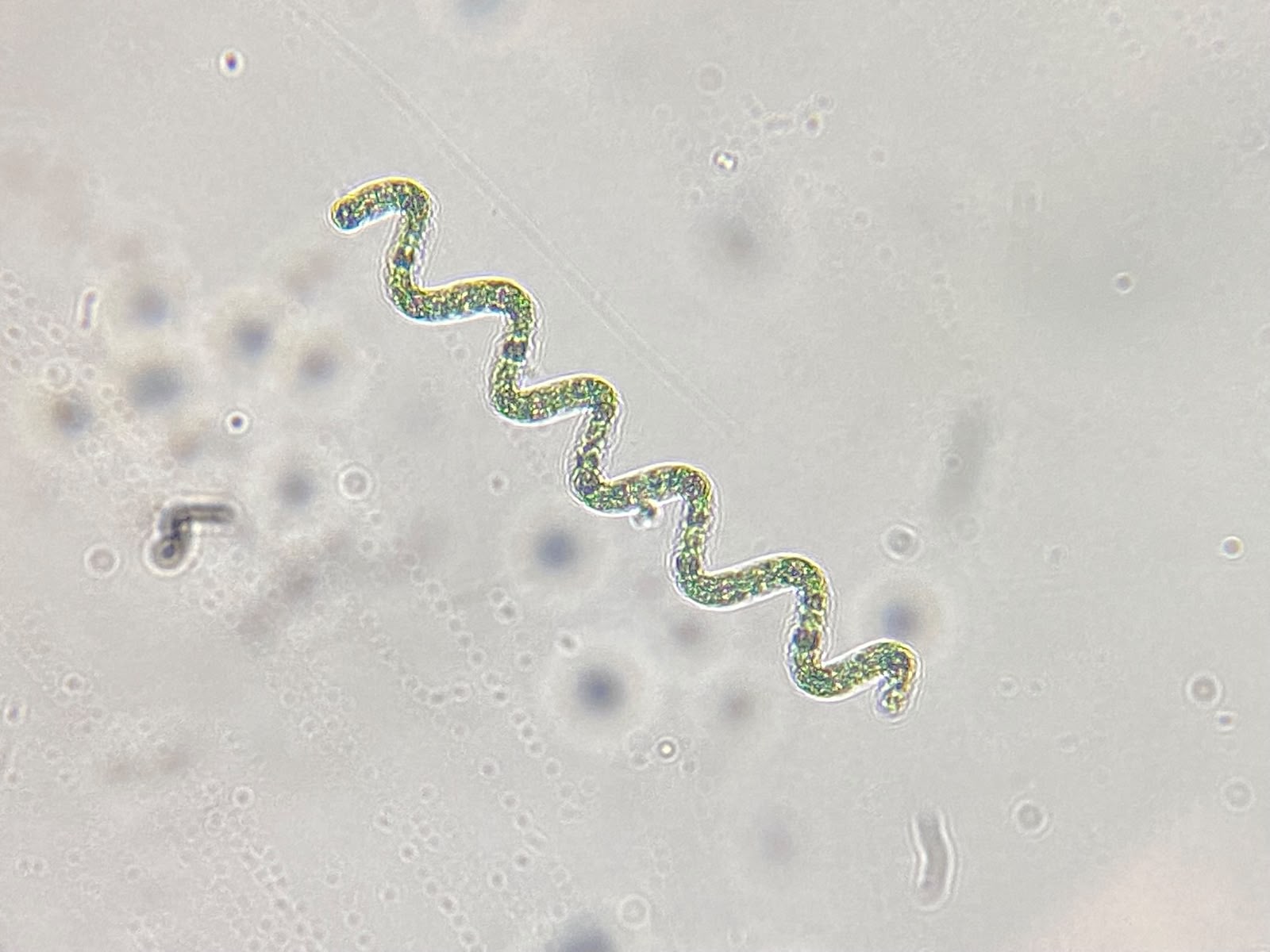
Then there is the shape. The spiral is a single row of cells, and it multiplies by breaking into pieces, each of which grows on its own.
The spiral is also a state. In their study of why Arthrospira coils, Chaiyasitdhi and colleagues gather what is known: strong light tightens the helix, a grazing predator can make the filament change its pitch and even its handedness, and stress such as nutrient shortage can straighten it out. Straight filaments grow more slowly. Their model estimates that coiling alone can make a filament up to two orders of magnitude stiffer; their AFM measurements found no change in the stiffness of the cells themselves. And straightening sticks. In one culture they cite, it took nine years for a helical filament to come back.
That is why we keep our own strains and look at them before we trust a batch. Biomass from someone else's pond arrives with someone else's history.
What it makes
By dry weight the biomass is 55 to 70% protein, 12 to 25% carbohydrate and 4 to 8% lipid, per the D'Ascoli review. Phycocyanin, the blue protein, makes up roughly 10 to 20% of the dry cell. Next to it sit allophycocyanin, a second blue protein that absorbs further into the red and gives us a purple, and chlorophyll, the green.
So one cell carries three colours and the protein they are built into. A plant that sells only the first colour is paying to grow the other three fractions and then paying again to get rid of them.
| Fraction | What it is | Where it goes |
|---|---|---|
| Phycocyanin | Water soluble blue protein, roughly 10 to 20% of dry weight | Colour for food and beverage |
| Allophycocyanin | Second water soluble phycobiliprotein, absorbs further into the red | A purple, in development |
| Chlorophyll | Fat soluble green pigment, the main contaminant of a blue extract | A green, in development |
| Protein, peptides, minerals | What remains after the pigments | Biostimulant |
How it comes out
The usual chain, as the alkaliphile review describes it: the biomass is dried at the farm, shipped, rewetted, broken, filtered, and the blue solution is spray dried. Two drying steps for one blue powder, and the review notes that the first one is there to move the biomass from the farm to the extraction plant.
Heat is the first limit. Phycocyanin degrades faster above 50 °C, so extraction runs between 25 and 47 °C. Bead milling breaks up to 98% of the cells and scales well, but it drags chlorophyll into the blue extract, and chlorophyll is the contaminant every purification step after it has to remove. The grades that come out of that purification are explained in how phycocyanin is graded.
The published work already shows that these fractions can be kept apart. Phycocyanin and allophycocyanin are both water soluble, and Porav and colleagues recovered more than 80% of both from A. platensis with aqueous two-phase systems and no chromatography column. Chlorophyll is fat soluble, which makes it a fraction of its own. The protein, peptides and minerals are a fourth fraction with buyers of their own.
The protein fraction is where most designs stop. The alkaliphile review closes its own flowsheet with an anaerobic digester, and we think that is the mistake. A team working from a geothermal spirulina plant in Iceland ran a life cycle assessment that sends the residue to degraded soils as a biostimulant. The soil carbon it added more than paid back the emissions of growing and extracting, so under their assumptions the blue came out carbon negative. They also wrote down the hard part: in sun grown ponds the residue changes from day to day and season to season, which makes a consistent biostimulant difficult.
Dose decides the rest. In a pot trial on common bean by Gharib and colleagues, algae extracts including Arthrospira raised yield when sprayed at up to 1%. At 2%, the same extracts pushed the plants into oxidative stress.
What it is worth at scale
Here is our mass balance. 1,000 kg of biomass gives about 50 kg of blue, 20 kg of green, 5 kg of purple and 150 kg of biostimulant.
The blue is in production as TintBlue E18, and it has to survive the product it goes into: it keeps 85% of its colour after 12 months in a pH 4.5 beverage at room temperature and tolerates a short pasteurisation at 72 °C. The green and the purple are still in development. The biostimulant is Alvium, and in the field it gave seedlings that grew 33% faster, one more fruit per watermelon plant and frost tolerance down to minus 7 °C.
The value sits in the split. The cost of growing the biomass is shared by four products, so the cost per use of each one lands below what a single extraction plant can reach at comparable purity. All of that gain is made after the harvest, with the same pond and the same biomass.
The first 250 litre reactor is running with our partner in India, and 1,500 litres are planned for January.
In that one culture, the spiral needed nine years to come back. A filament that stubborn deserves a process that uses all of it.
Sources
- Peest TM, Stellner NI, Viswanathan S, Lau R, Garbe D, Brueck TB. From microalgal biomass to products: downstream processing technology gaps and the road to commercial diversification. Microorganisms, 2026. 10.3390/microorganisms14071393
- Yi L, Solanki R, Moll M, Vadlamani A, De la Hoz Siegler H, Strous M. Toward sustainable phycocyanin production using halo-alkaliphilic cyanobacteria: from direct air capture of carbon dioxide to biorefinery. Front Microbiol, 2025. 10.3389/fmicb.2025.1618123
- D'Ascoli M, Langellotti AL, Russo GL, Sorrentino A, Di Pierro P. Phycocyanin extraction from Limnospira spp.: sustainable source of natural blue color for the food industry. Curr Res Food Sci, 2025. 10.1016/j.crfs.2025.101141
- Chaiyasitdhi A, Miphonpanyatawichok W, Riehle MO, et al. The biomechanical role of overall-shape transformation in a primitive multicellular organism: a case study of dimorphism in the filamentous cyanobacterium Arthrospira platensis. PLoS One, 2018. 10.1371/journal.pone.0196383
- Porav AS, Bocăneală M, Fălămaş A, et al. Sequential aqueous two-phase system for simultaneous purification of cyanobacterial phycobiliproteins. Bioresour Technol, 2020. 10.1016/j.biortech.2020.123794
- Smidt-Jensen A, Røgild TB, Cohen T, Meshoulam S, Iuclea L, Sigurjónsson HÆ, et al. Life cycle assessment of phycocyanin food colorant production from spirulina with biostimulant waste-stream utilization for soil carbon sequestration to achieve net carbon removal. Foods, 2026. 10.3390/foods15040610
- Gharib FAEL, Osama K, Sattar AMAE, Ahmed EZ. Impact of Chlorella vulgaris, Nannochloropsis salina, and Arthrospira platensis as bio-stimulants on common bean plant growth, yield and antioxidant capacity. Sci Rep, 2024. 10.1038/s41598-023-50040-4
The mass balance, the retention and heat figures for TintBlue E18 and the Alvium field results are ours.


