
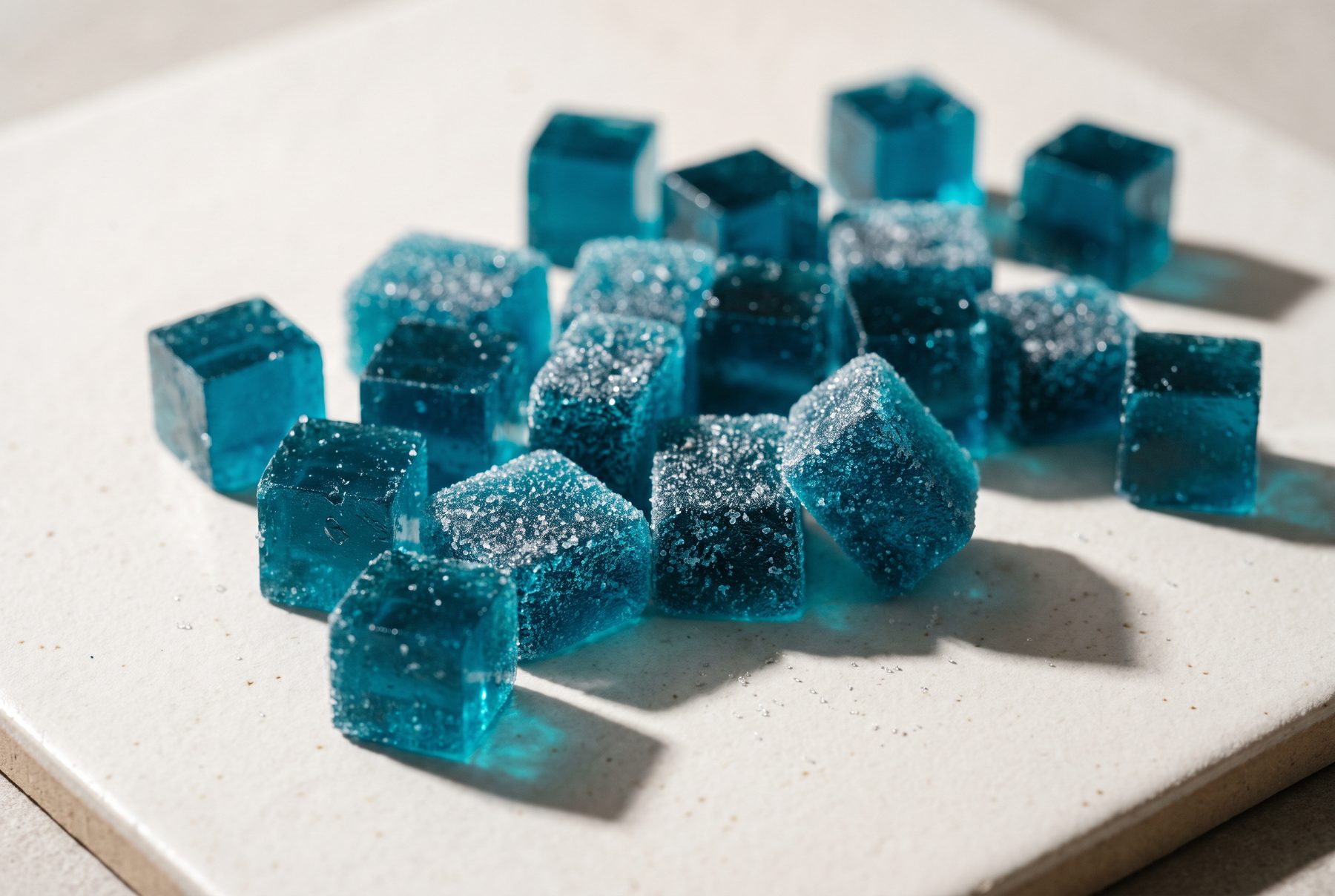
A gummy is the format that asks phycocyanin for everything at once. The mass is acidified to pH 3.5 to 4.0 for flavour and set. It is 70 to 80% sugar solids. It is cooked above 100 °C and deposited hot. Then it sits in a clear jar on a shelf. A supplier who says the blue "works in gummies" without numbers has not made one.
It does work. The order of operations is what decides it.
Pectin, not gelatin, and here is why
Gelatin gummies deposit at 60 to 70 °C and set as they cool. Pectin gummies deposit cooler and set on acid and calcium rather than on temperature. That difference alone is a reason to prefer pectin for this pigment, since every degree of deposit temperature is time the protein spends unfolding. There is a second reason, and it is chemical.
Buecker and colleagues complexed phycocyanin with pectin at increasing ratios and then heated the complexes to 85 °C. At a pectin to phycocyanin ratio of 0.67 the protein sat on the surface of the complexes, aggregated on heating and precipitated. At a ratio of 2.0 or above the complexes were smaller, the protein was held inside them, and they stayed in suspension after the heat step, in their paper on the colloidal stability of pectin phycocyanin complexes. Their practical note names the products this matters for: soft drinks and hard candy, which is to say acidified systems that get hot. A pectin gummy is one of those, and it carries its own protective polymer in the recipe.
Gelatin does not give the same protection, and gelatin gels are the matrix in which Brauch and colleagues measured the fastest light fade for spirulina blue, a half life of 4 days under illumination, in their comparison of blue colorants. A gelatin gummy can be coloured blue. It should be packed opaque and it will carry less margin.
The sugar is on your side
Sugar is usually the enemy of a stability claim. Here it is the opposite. Faieta and colleagues heated phycocyanin in water and in sucrose and trehalose solutions and found that colour loss fell as the sugar concentration rose, with sucrose protecting better than trehalose, and circular dichroism showing the sugar holding the protein in its native fold, in their study of saccharides and thermal stability. Sasi Rekha and colleagues took that to 40% sucrose in an agar hydrocolloid and reported the native conformation of the protein preserved, with the sugar raising the temperature at which it degraded, in their work on additives in a phycocyanin agar hydrocolloid.
A gummy mass is denser in sugar than either of those systems. The protein is going into the most protective environment it will ever see, which is why a deposit that would destroy the pigment in water is survivable in a gummy. It also means a sugar free gummy on polyols is a different trial. Selin and colleagues found phycocyanin stable across sucrose, fructose, dextrose, sorbitol and xylitol in a chilled cheesecake filling, in their comparison of natural colorants across sweeteners, but that is a cold product and the hot deposit still has to be run on the polyol mass before anyone promises a shade.
The acid is fine if it is buffered
The mass runs at pH 3.5 to 4.0. Our specification for the colour holds from pH 4.0 and says to keep the product above 3.5 at all times, so a gummy sits at the bottom of the window. Two things keep it inside. Buffer the acid with sodium citrate rather than adding free citric acid to a hot mass, so the pigment never meets a local pH spike at the addition point. And add the pigment late: into the cooled mass before deposit, not into the cook.
Patel and colleagues measured the denaturation kinetics across the pH range and found the protein several times more stable at pH 5 than at pH 7, in their study of thermal denaturation kinetics. Acid is not the threat inside the window. Heat in acid is, and the fix is time: the shorter the interval between pigment addition and set, the more colour survives.
The numbers we run
The starter formula on our data sheet is a pectin gummy at 2.5 g of TintBlue E18 per kg of mass, which is 0.25% w/w, at pH 3.8, buffered with sodium citrate, deposited fast. For a supplement gummy carrying Phycora as the active rather than as the colour, the dose is 5 to 50 mg of phycocyanin per piece, added to the cool phase before set, and pectin is preferred for the same reasons.
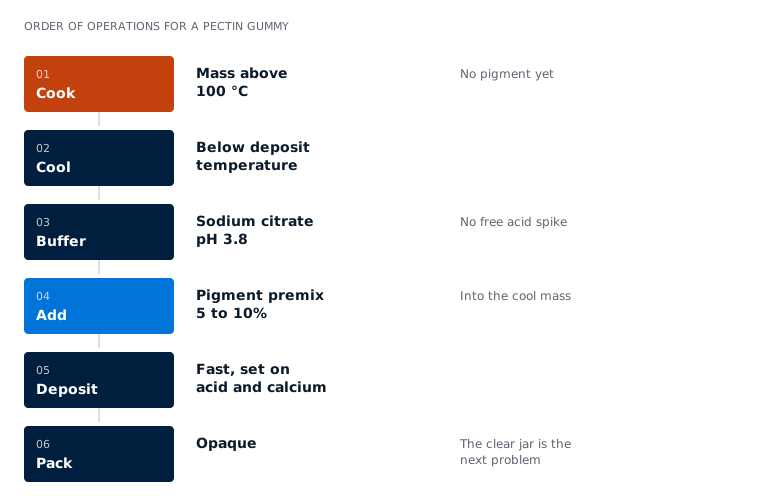
Pre-disperse the powder at 5 to 10% in cold deionised water before it goes anywhere near the mass. Add it in the cool down, below the deposit temperature. Deposit and set as fast as the line allows. Pack opaque, because the clear jar is the next problem and it is a slow one.
What to do with this
Choose pectin. Add late, buffered, into a cooled mass. Run the sugar free version as its own trial. And take the sample: 30 g of E18 at 0.25% is 12 kg of gummy mass, which is a full pilot batch on most depositors.
Sources
According to PubMed:
- Buecker S, Gibis M, Bartmann L, Bussler S, Weiss J. Improving the colloidal stability of pectin-phycocyanin complexes by increasing the mixing ratio. J Food Sci, 2024. 10.1111/1750-3841.16917
- Brauch JE, Zapata-Porras SP, Buchweitz M, Aschoff JK, Carle R. Jagua blue derived from Genipa americana L. fruit: a natural alternative to commonly used blue food colorants? Food Res Int, 2016. 10.1016/j.foodres.2016.08.029
- Faieta M, Neri L, Sacchetti G, Di Michele A, Pittia P. Role of saccharides on thermal stability of phycocyanin in aqueous solutions. Food Res Int, 2020. 10.1016/j.foodres.2020.109093
- Sasi Rekha V, Sankar K, Rajaram S, Karuppiah P, Dawoud TMS, Syed A, Elgorban AM. Unveiling the impact of additives on structural integrity, thermal and color stability of C-phycocyanin agar hydrocolloid. Food Chem, 2024. 10.1016/j.foodchem.2024.139000
- Selin C, Tanislav A, Stan L, et al. Exploring the phytochemical and physical stability of phycocyanin, anthocyanins, and betacyanin in a cheesecake product. Mol Nutr Food Res, 2025. 10.1002/mnfr.70191
- Patel A, Pawar R, Mishra S, Sonawane S, Ghosh PK. Kinetic studies on thermal denaturation of C-phycocyanin. Indian J Biochem Biophys, 2004. PubMed 22900283
The starter formula and the dose ranges are from the application guides for TintBlue E18 and Phycora.

