
A buyer searching for phycocyanin finds E18 offered at 60 to 75 USD a kilo, then finds our price list and reads 180 EUR. The reasonable conclusion is that somebody is wrong.
We get asked about it most weeks, usually with some embarrassment, as though it were a rude question. It is the right question. The two numbers are prices of different things, and neither of them is what a plant actually spends, so here is the whole thing written down, with our own prices in it.
A kilo of powder is not a kilo of colour
The grade code is a concentration, not a quality rating. E18 means 180 colour units per gram, read as absorbance at 620 nm on a 1% solution. E40 means 400. Divide any price by the colour value and you get the price of colour, which is the first number that compares across suppliers.
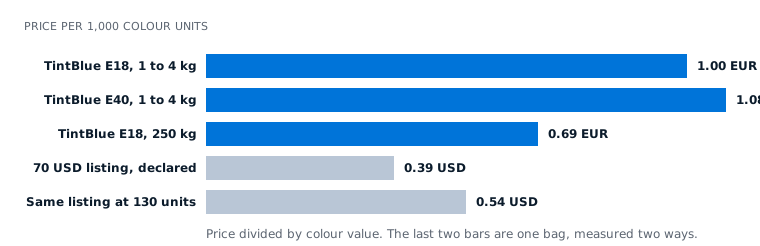
Ours works out at 1.00 EUR per 1,000 colour units for E18, and 0.69 EUR once you are buying 250 kg. E40 lands at 1.08 EUR, and 0.74 EUR at volume. The two grades price within about 10% of each other per unit of colour, which is deliberate: choosing between them is a decision about carrier, freight and who owns the excipient system, and we would rather it never became a decision about price.
A listing at 70 USD declaring 180 colour units comes out at 0.39 USD per 1,000. On that arithmetic it wins, and it deserves to. Everything after this is about whether the bag holds what the listing declares, and what happens if it does not.
What the cheap bag usually is
Most of the phycocyanin quoted at those prices comes out of China, often through a trading desk rather than from the plant that produced it. That is not an accusation. Some of that material is perfectly good, and at industrial volumes some of it is a genuinely better buy than ours. It does mean the person selling it cannot always tell you which pond it grew in, what the drying conditions were, or why lot 14 behaved differently from lot 9, because they were not there either.
It also puts a floor under the conversation that is worth knowing about. Chaiklahan and colleagues costed a stepwise extraction of phycocyanin, lipids and polysaccharides from Arthrospira in their economic feasibility study. Food grade phycocyanin came out at 8.66% of biomass dry weight and a production cost of 249.70 USD per kilo, and they found that biomass below 15% phycocyanin on dry weight leaves the investment underwater. One pilot plant is not a market, and a large operation with cheap biomass lands well under that figure. But when a price sits far below a published cost, something specific explains it: scale, purity, carrier, or accounting. Any of those can be fine. It is worth knowing which one you bought.
Then there is the older problem, which is that a name on a bag and the contents of a bag are two separate pieces of information. Park and colleagues measured pigment content across seven commercial spirulina powders and against material they prepared themselves, in their study of carotenoids and C-phycocyanin. Their own preparation carried the most of every pigment they tracked, which they put down to degradation during mass production, and the carotenoid profiles sorted the commercial samples into two groups, consistent with two different organisms sold under one name.
Which is why the colour value belongs on a certificate of analysis for the lot in front of you, and not on a data sheet. A data sheet is a promise. A certificate is a measurement. When a quote is unusually cheap and the certificate is generic, the discount and the missing measurement tend to be the same thing.
The number your plant actually spends
Price per kilo of powder is a purchasing number. Cost per kilo of finished product is the one that reaches the P&L, because it carries the inclusion rate with it, and it usually ends the argument.
Take a blue ready to drink beverage at 0.10% w/w, in the middle of our specified 0.05 to 0.30% range.
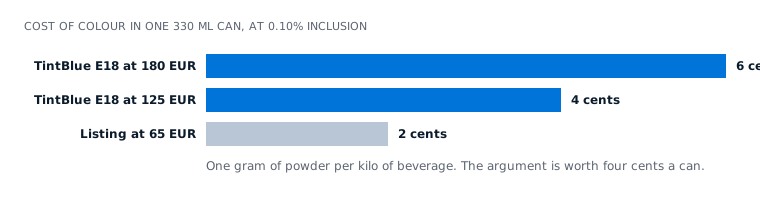
One gram per kilo of product at 180 EUR a kilo is 0.18 EUR per kilo of beverage, or 6 cents in a 330 mL can. At our 250 kg price it is 4 cents. At 65 EUR a kilo it is 2 cents. Across 100,000 cans the spread between cheapest and dearest is around 4,000 EUR, which is real money and also about a day of the marketing budget for the same launch.
Now put the other side of the ledger next to it. Our E18 holds 85% of its colour at 12 months in a pH 4.5 beverage at ambient, 92% at pH 4.0 held cold, and 60% at pH 4.0 at ambient. We publish the third number because it is the one that tells a formulator where this ingredient stops working, and a supplier who only shows you the best of three is not being generous with the other two. A batch that turns grey in month four is no longer a colour problem. It is a recall conversation, and it costs more than the four cents ever saved.
What the 180 EUR includes, besides the powder: a certificate of analysis for your lot with the colour value and the C-phycocyanin measured on it, the stability figures above with their pH and their months attached, an application guide with reference formulas, a named collection point on every published price, production in 3 to 5 weeks, and an email address where somebody who knows the process answers the same day. We make it in a plant in India that we chose and audited, which is the reason we can answer the question about lot 14.
We would rather sell 250 kg than 1 kg. We sell from 1 kg anyway, because that is what an honest trial costs, and a supplier who only talks to large accounts has decided in advance who is allowed to try.
If you are comparing quotes this quarter, the five things to ask are the colour value and C-phycocyanin measured on the lot rather than specified in a document, what the carrier is and what share of the bag it takes, which organism it came from and where it was grown and processed, the retention with its pH and temperature and matrix and months, and what the price becomes at the volume you will really buy and on which incoterm. A supplier who answers with five measurements is selling a process. A supplier who answers with a brochure is selling a bag.
Ours is free to check. The sample is 30 g of E18 or 10 g of E40, it ships with the certificate for the lot you receive, and everything above can be verified on our material before anybody commits to a kilo.
Sources
According to PubMed:
- Chaiklahan R, Chirasuwan N, Loha V, Tia S, Bunnag B. Stepwise extraction of high-value chemicals from Arthrospira (Spirulina) and an economic feasibility study. Biotechnol Rep, 2018. 10.1016/j.btre.2018.e00280
- Park WS, Kim HJ, Li M, et al. Two classes of pigments, carotenoids and C-phycocyanin, in spirulina powder and their antioxidant activities. Molecules, 2018. 10.3390/molecules23082065
Prices, bands and terms are ours, from the pages for TintBlue E18 and TintBlue E40. What the grade codes measure is covered in the article on grades and the purity ratio.

