
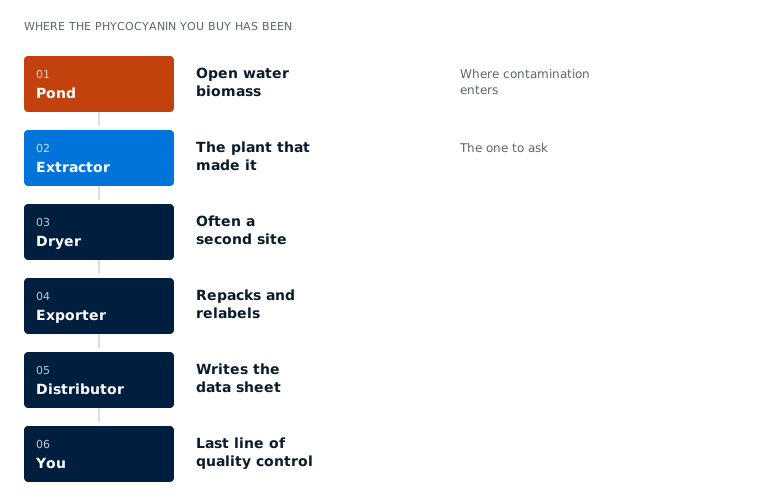
Most phycocyanin on the market is bought from somebody who did not make it. The biomass is grown in an open pond, extracted at one plant, dried at another, traded through an exporter and a distributor, and arrives with a data sheet that was written for a different lot. None of that is a scandal. It is how commodity ingredients move. But it means the buyer is the last line of quality control, and the tools for that job are questions.
Why the questions matter: what the surveys found
Spirulina is a cyanobacterium and it is grown in water that other cyanobacteria would also like to live in. Some of those produce microcystins, hepatotoxins with a tolerable daily intake. Rhoades and colleagues examined five retail spirulina products, two supplements and three foods, and detected microcystins in all five at levels that could take a consumer past the recommended daily limit, along with potentially pathogenic bacteria, in their study of retail spirulina microbiota and cyanotoxins. Roy-Lachapelle and colleagues analysed 18 algal supplements containing spirulina or Aphanizomenon and found cyanotoxins above tolerable daily intake in 8 of them, in their detection of cyanotoxins in algae dietary supplements.
The picture is not uniform, and that is the point. Heussner and colleagues, testing thirteen products in Germany, found microcystins only in the Aphanizomenon products and none in the spirulina ones, in their analysis of toxin content in algal supplements. Pinchart and colleagues collected 623 dry spirulina analyses from 95 small French producers over eight years and found the production within safe regulatory levels for microcystins, while cataloguing 14 contaminant taxa in the ponds, in their survey of French small-scale spirulina production. Clean biomass exists. So does contaminated biomass. The certificate is how you tell which one you bought.
The same logic applies to heavy metals. Spirulina concentrates what is in its water, and the extraction step does not remove metals that came in with the cells. Lead, arsenic, cadmium and mercury belong on the certificate as measured numbers by ICP-MS, not as a line reading "complies".
The nine questions
1. What is the colour value of this lot, and how was it measured? The E number is absorbance of a 1% solution at 620 nm across 1 cm, divided by 10. A supplier who cannot say which of those conditions they used cannot be compared with one who can.
2. What is the purity ratio? A620 over A280 says how much of the protein in the bag is phycocyanin. Sala and colleagues give the conventions: above 0.7 for food, above 1.5 for cosmetics, above 4.0 for analytical work, in their paper on extraction at food grade purity. A food colour quoted at a ratio above 4 is a laboratory number attached to a food product.
3. What is on the carrier, and how much of the gram is it? Trehalose, maltodextrin, sodium citrate, nothing. An E18 is about a quarter phycocyanin. The rest should be named.
4. Heavy metals, by lot, by ICP-MS. Four numbers with units. Not a statement of compliance.
5. Microcystins. Whether the biomass is tested, by which method, and what the result on this lot was. A supplier who does not test should say so, and the buyer should decide what that is worth. We test every lot, and the result is on the certificate.
6. Microbiology on the finished powder. Total plate count, yeast and mould, E. coli, Salmonella. The Rhoades survey found Bacillus cereus in retail product; a colour that goes into a beverage cannot bring that with it.
7. Retention, with the conditions. A single retention percentage means nothing. The matrix, the pH, the temperature and the duration are the claim; the number is what they produced. Ask for all five and ask what the packaging was.
8. Regulatory status in your market, in writing. In the European Union, spirulina extract as a colouring food under Regulation 1333/2008. In the United States, spirulina extract (color) under 21 CFR 73.530. In Mercosur, GMC 11/2006. A supplier who cannot cite the regulation cannot help when your regulator asks.
9. Who extracted it? Not who sold it. The name of the plant, the country, and whether the person you are emailing can call somebody who was on the floor when the lot was made. When a lot behaves differently on your line, that call is the whole value of the relationship.
The sample policy tells you the rest
A supplier who sends a sample sized to run a real trial, with the certificate of analysis for that lot and the data sheet, is telling you they expect you to check. One who sends a 5 g sachet and a brochure is telling you something else. The trial should be run on colour units delivered, in your matrix, through your heat step, in your pack, and the certificate that arrives with the first kilo should match the sample.
What we put on ours
Colour value and C-phycocyanin content on every lot. Purity ratio. The carrier, named, or its absence. Lead, arsenic, cadmium and mercury by ICP-MS with the limits beside them. Microcystins, analysed on every lot. Microbiology. Retention with the matrix, pH, temperature and duration printed next to each figure, and the packaging requirement on the same page. The regulation for each market. The plant. And a sample of 30 g for the food grade and 10 g for the concentrate, free, with the certificate for the lot it came from, because the questions above are the ones we would ask.
Sources
According to PubMed:
- Rhoades J, Fotiadou S, Paschalidou G, et al. Microbiota and cyanotoxin content of retail spirulina supplements and spirulina supplemented foods. Microorganisms, 2023. 10.3390/microorganisms11051175
- Roy-Lachapelle A, Solliec M, Bouchard MF, Sauvé S. Detection of cyanotoxins in algae dietary supplements. Toxins, 2017. 10.3390/toxins9030076
- Heussner AH, Mazija L, Fastner J, Dietrich DR. Toxin content and cytotoxicity of algal dietary supplements. Toxicol Appl Pharmacol, 2012. 10.1016/j.taap.2012.10.005
- Pinchart PE, Leruste A, Pasqualini V, Mastroleo F. Microcystins and cyanobacterial contaminants in the French small-scale productions of spirulina. Toxins, 2023. 10.3390/toxins15060354
- Sala L, Moraes CC, Kalil SJ. Cell pretreatment with ethylenediaminetetraacetic acid for selective extraction of C-phycocyanin with food grade purity. Biotechnol Prog, 2018. 10.1002/btpr.2713
What we publish per lot is on the product pages for TintBlue E18, TintBlue E40 and Phycora.


