
Every European buyer asks the same question in the first call, usually in the first five minutes: what is the E number. Spirulina blue does not have one. The answer that matters is why, because the reason decides what you can put the ingredient in, what the label has to say, and which documents have to exist before a product ships.
Two routes, one regulation
Regulation (EC) No 1333/2008 governs food additives in the EU. Annex I of that regulation describes colours as substances that add or restore colour in a food, and then adds the sentence that the whole question turns on: preparations obtained from foods and other edible natural source materials, obtained by physical or chemical extraction resulting in a selective extraction of the pigments relative to the nutritive or aromatic constituents, are colours within the meaning of the regulation.
Article 3(2)(a)(ii) carves out the other route. Foods, dried or in concentrated form, added for their nutritive or aromatic properties with a secondary colouring effect, are not food additives at all. They are ingredients. The working term for them is colouring foods, and they are what most natural blue, red and green on European shelves is.
So there are two doors. Through one, an extract is an additive: it needs authorisation, it gets an E number, it appears in Annex II with the categories and maximum levels it is allowed in, and it has to meet the purity criteria of Regulation (EU) No 231/2012. Through the other, an extract is a food ingredient: no E number, no Annex II list, and the general food law applies instead.
Spirulina extract goes through the second door. The consequence buyers care about is that there is no list of permitted categories to check, because ingredients are not listed that way.
What decides which door
The regulation says selective extraction and stops there. It gives no number. The Commission services filled that gap with guidance notes on the classification of food extracts with colouring properties, endorsed by a large majority of Member State representatives at the Standing Committee on 29 November 2013. The notes are explicit that they are not legally binding and were not adopted under Article 19(c). They also recommend that operators work to them from 1 January 2014, and that everything placed on the market after 29 November 2015 be in line. In practice they are what an enforcement officer opens.
The test they set out is a ratio. Take the pigment content of the extract, divide it by the nutritive constituents of the extract, and compare that ratio against the same ratio in the source material.
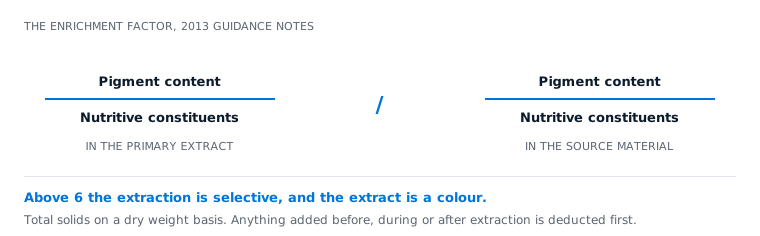
Three details in that calculation decide most real cases. The reference basis for the nutritive constituents is total solids, everything but water, expressed on a dry weight basis. Anything added before, during or after extraction has to be deducted, so a carrier is not part of the primary extract and cannot be used to dilute the ratio. And the threshold is a single number: above 6 the extraction is selective, and the product is a colour.
The guidance is equally clear about who does this work. The producer and the user of a colouring food carry the responsibility of proving that the extract is an ingredient and not an additive, including the data on the source material, the compositional analysis, the enrichment factor calculation and the description of the manufacturing process.
That sentence is the practical content of this whole article. The classification is not a certificate you receive with the bag. It is a file that a supplier and a customer build together, and it lives with both of them.
What it means for a concentrated blue
A grade sold at high colour value is exactly where the calculation earns its keep, because the enrichment factor is run on the primary extract and not on the bag. A carried grade and a carrier free concentrate made from the same extract are the same case in this framework. The carrier is deducted either way.
So the question to put to any supplier of spirulina blue in Europe is not whether the product is a colouring food. It is whether they hold the compositional data and the enrichment factor calculation that support the answer, and whether they will give them to you. A supplier who has never heard of the enrichment factor has not made the classification, they have inherited it.
What the ingredient route asks of you instead
Not needing an E number does not mean nothing applies. Four things follow from being an ingredient rather than an additive.
The label declares it by name in the ingredient list, like any other ingredient, and the labelling exemptions that apply to additives do not apply. Use must not mislead the consumer, which is the general food law doing the work that Annex II does for additives. Contaminants fall under Regulation (EC) No 1881/2006 rather than the purity criteria of 231/2012. Extraction solvents fall under Directive 2009/32/EC. And aluminium lakes, which are authorised for some colours, are not authorised for colouring foods at all.
There is one more asymmetry worth knowing. Additives that are added to a colouring food fall under Annex III of 1333/2008, which is a different list from the Annex II one that governs additives in food. A preservative in a colour and a preservative in a colouring food are read against different tables.
The other door is being opened by someone else
The additive route for a blue phycocyanin is not theoretical. In March 2026 the EFSA panel on food additives and flavourings published its safety evaluation of blue galdieria extract as a food additive, an enzymatically treated C-phycocyanin extract from the lysed biomass of Galdieria sulphuraria containing over 25% C-phycocyanin. The panel found it was not genotoxic, saw no treatment related adverse effects in a 90 day study up to the highest dose tested, and expected a low allergenicity risk. It also acknowledged the similarity between the C-phycocyanins of G. sulphuraria and Arthrospira platensis, and used the existing spirulina toxicity data on that basis. The same material was cleared by the FDA as a colour additive in June 2025.
Read that as a market signal rather than a regulatory threat. The molecule that colours a spirulina blue is being assessed by EFSA on spirulina data, and a second route to a blue in Europe is being built through the additive door while the ingredient door stays open. A formulator choosing a blue this year should know both exist.
What to have in the file before you launch
The composition of the extract and of the source material, and the enrichment factor calculated from them. The specification, and a certificate of analysis for the lot you actually received rather than a generic one. The contaminant testing that 1881/2006 asks for. The exact ingredient declaration you intend to print. And a note recording who ran the classification and on what data, because the question arrives years later, usually from a customer's auditor and not from an authority.
We ship TintBlue E18 and E40 as spirulina extract, with the certificate of analysis for the lot in the box, and we send the compositional data a customer needs for this file when they ask for it. The 30 g sample comes with the same paperwork as an order, which is the point of sending it: the regulatory conversation and the stability trial can run on the same lot, at the same time.
Sources
- Regulation (EC) No 1333/2008 on food additives, Annex I and Article 3(2), consolidated text on EUR-Lex
- European Commission services, Guidance notes on the classification of food extracts with colouring properties, version 1, 29 November 2013
- EFSA Panel on Food Additives and Flavourings. Safety evaluation of blue galdieria extract as a food additive. EFSA Journal, 2026. 10.2903/j.efsa.2026.9960
This article describes the framework and is not regulatory advice for a specific product. What the grade codes measure is covered in the article on grades and the purity ratio, and the commercial side of the same decision in what you pay for in a kilo of phycocyanin.

