
Dairy asks less of phycocyanin than a beverage does. The pH sits in the middle of the window, the protein around it is friendly, and the cold chain that dairy already runs on is the storage condition the pigment wants. What dairy does instead is change the shade, and a formulator who has matched a blue in water is surprised by what comes out of the vat.
Milk protein is on the pigment's side
Zhang and colleagues, at Cornell, added whey protein isolate to C-phycocyanin at pH 3.0 and stored it under light for five days. At 0.05 to 0.1% the whey protein delayed the colour loss by about two days, and infrared and fluorescence spectroscopy showed the whey protecting the alpha helix of the pigment protein. At a much higher whey concentration, around 1%, after a heat treatment, the effect reversed and the colour went faster. The work is in their paper on whey protein and phycocyanin under light.
Two things for a dairy formulator in that result. Milk protein at the levels a drink or a yogurt carries is a stabiliser, which is part of why dairy is easy. And a high protein product that is heat treated after the pigment goes in is the one case to test on its own, because more protein plus heat is where the Cornell result turned.
Fat lightens the shade
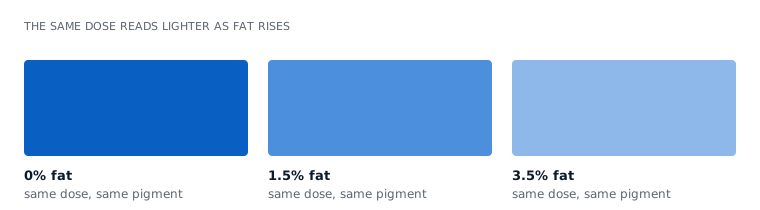
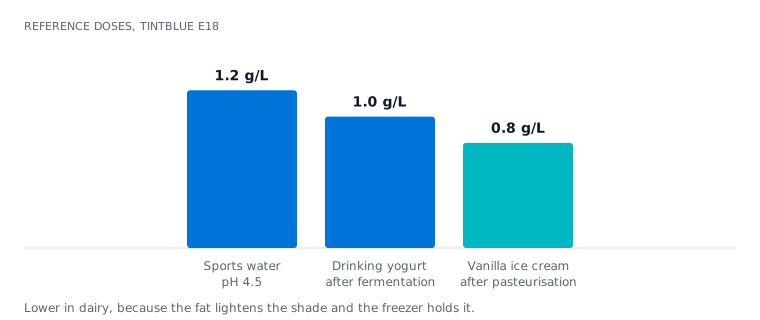
Phycocyanin is water soluble and sits in the serum phase. In a full fat product the fat globules scatter light and the blue reads paler and more pastel than the same dose in skim. This is not a loss of pigment. It is optics, and it is reversible: the same dose in a 0% yogurt is a deeper blue than in a 3.5% one. Our ice cream reference is a vanilla base at 0.8 g per litre, 0.08% w/w, which is lower than the beverage dose and gives a pastel because the fat does the rest. Match the shade in the product, at the fat content it will ship at, and expect to dose up in skim and down in cream.
Fermentation sets the pH, and it is a good one
A set or stirred yogurt finishes at pH 4.2 to 4.6, inside the window and above the 4.0 floor of our specification. The pigment goes in after fermentation, once the base is below 8 °C, never before, because the culture step spends hours warm and the pigment does not need to be there for it. Our reference is a drinking yogurt at 1.0 g per litre, 0.10% w/w, added cold after fermentation. Nourmohammadi and colleagues, working with whole spirulina biomass rather than the extract, found that encapsulating it in whey protein and alginate fixed the sensory problems of the biomass in stirred yogurt and kept the pH higher through storage, in their study of microencapsulated spirulina in yogurt. The extract does not carry the biomass flavour, so that step is not needed for colour; the finding matters because it shows the yogurt matrix tolerating the addition without syneresis or texture loss.
The freezer holds the blue for six months
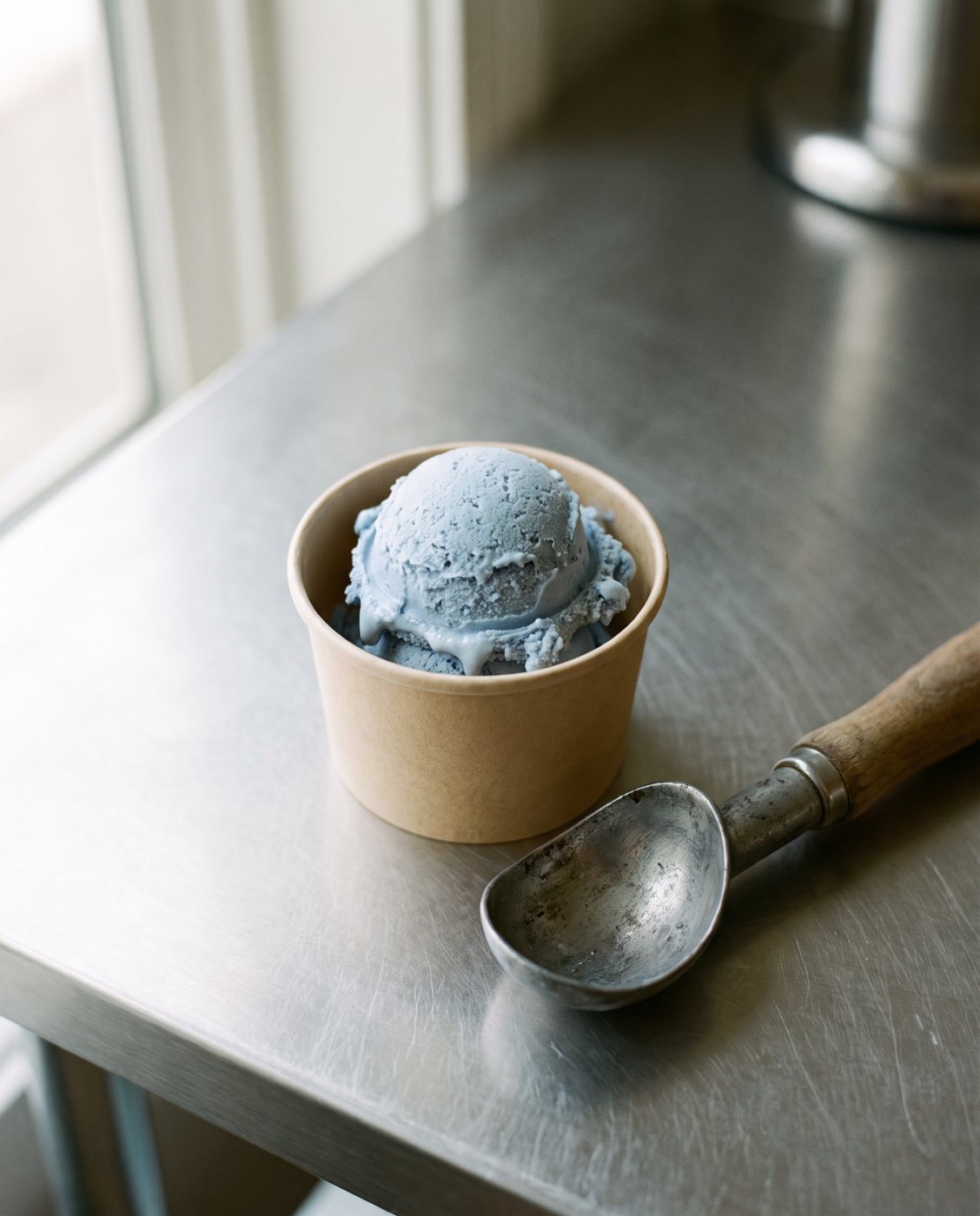
The best dairy stability result in the literature is in ice cream. Campos Assumpção de Amarante and colleagues added a food grade C-phycocyanin extract to milk based ice creams and measured the colour over 182 days of frozen storage. The loss was insignificant. They also found the antioxidant capacity of the ice cream after simulated digestion two to thirteen times higher than the controls, in their paper on colour stability in phycocyanin ice creams.
Cold and dark is the condition every stability study on this pigment points at, and a frozen dessert is cold and dark for its whole life. Sasi Rekha and colleagues, in a different system, found that a phycocyanin and sucrose agar hydrocolloid added to ice cream at 5% cut the melting rate by up to five times, with sucrose holding the protein in its native fold, in their work on additives in a phycocyanin agar hydrocolloid. Ice cream carries the sugar that protects the protein and the temperature that stops the clock.
The heat step is before the pigment, not after
Ice cream mix is pasteurised at 80 to 85 °C. That is outside the pigment's window, and it does not matter, because the pigment goes in after pasteurisation and homogenisation, into the cooled mix before ageing. Our reference formula is explicit: added after pasteurisation. The same rule holds for yogurt, where the milk is heat treated before the culture and the pigment is added after fermentation. In dairy the pigment never needs to see the heat, which is the reason dairy is where most first launches of a natural blue happen.
Patel and colleagues' kinetics apply if a process does put the pigment through heat: the protein is several times more stable at pH 5 than at 7, in their study of thermal denaturation, so a cultured product tolerates a warm step better than a neutral milk drink does. Plan around not needing it.
What to do with this
Add cold, after every heat step. Match the shade at the fat content that ships. Pack opaque, because a clear cup on a lit dairy shelf is the one place this matrix gets into trouble. For a frozen product, dose low and expect it to hold. A 30 g sample at 0.08 to 0.10% is 300 to 375 kg of mix, which is a full pilot run on either line.
Sources
According to PubMed:
- Zhang S, Zhang Z, Dadmohammadi Y, Li Y, Jaiswal A, Abbaspourrad A. Whey protein improves the stability of C-phycocyanin in acidified conditions during light storage. Food Chem, 2021. 10.1016/j.foodchem.2020.128642
- Nourmohammadi N, Soleimanian-Zad S, Shekarchizadeh H. Effect of Spirulina (Arthrospira platensis) microencapsulated in alginate and whey protein concentrate addition on physicochemical and organoleptic properties of functional stirred yogurt. J Sci Food Agric, 2020. 10.1002/jsfa.10576
- Campos Assumpção de Amarante M, Cavalcante Braga AR, Sala L, Juliano Kalil S. Colour stability and antioxidant activity of C-phycocyanin-added ice creams after in vitro digestion. Food Res Int, 2020. 10.1016/j.foodres.2020.109602
- Sasi Rekha V, Sankar K, Rajaram S, Karuppiah P, Dawoud TMS, Syed A, Elgorban AM. Unveiling the impact of additives on structural integrity, thermal and color stability of C-phycocyanin agar hydrocolloid. Food Chem, 2024. 10.1016/j.foodchem.2024.139000
- Patel A, Pawar R, Mishra S, Sonawane S, Ghosh PK. Kinetic studies on thermal denaturation of C-phycocyanin. Indian J Biochem Biophys, 2004. PubMed 22900283
The two reference formulas are from the application guide for TintBlue E18.

