
Search for the blue in a smoothie bowl and the result is "blue spirulina", a pouch, a price per ounce and a promise. Search for the blue in a sports drink and the result is "spirulina extract", a drum, a price per kilo and a data sheet. They are the same molecule, phycocyanin, and almost nothing else about them is the same. A buyer who prices one against the other is comparing a retail margin to a colour value.
Spirulina is green. Blue spirulina is what is taken out of it
Spirulina powder, the green one, is the whole dried cell of Arthrospira platensis. It is roughly 60% protein, of which 10 to 20% is phycocyanin, and it tastes of the pond. "Blue spirulina" is the phycocyanin extracted out of that cell in water, with the chlorophyll and the cell walls left behind, and dried. The word spirulina stays on the pouch because it sells; the product inside is an extract, and on an ingredient list that is what it must be called.
The number that separates the pouch from the bag
Every phycocyanin extract carries a colour value: the absorbance of a 1% solution at 620 nm across 1 cm, divided by 10. It says how much blue a gram delivers. The retail pouch is usually E3 to E6. The industrial bag is E18 to E40. A retail scoop of E4 into a smoothie colours it blue because a smoothie is a small volume and the scoop is generous; the same scoop would be invisible in a 1,000 litre batch. At E18 a gram colours 10 to 60 kg of finished product at typical use levels.
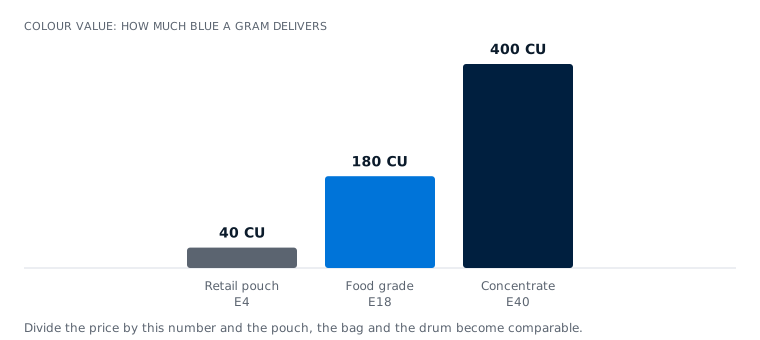
The price follows the colour value, or should. Divide the price per gram by the colour value and the pouch and the bag can finally be compared, and the comparison is not close, because the pouch is paying for a printed bag, a retail shelf and a dilute grade. That is not a criticism of the pouch. It is a different product for a different buyer.
Purity is the second number, and it is where the surveys bite
The colour value says how much blue. The purity ratio, absorbance at 620 divided by absorbance at 280, says how much of the protein in the powder is the pigment rather than the rest of the cell. Sala and colleagues give the conventions: above 0.7 for food, above 1.5 for cosmetics, above 4.0 for analytical use, in their paper on extraction at food grade purity. A pouch rarely states it. A bag should.
The retail end of the market is also where contamination has been measured. Rhoades and colleagues tested five retail spirulina products and found microcystins in all five at levels that could push a consumer past the daily limit, plus potentially pathogenic bacteria, in their study of retail spirulina microbiota and cyanotoxins. Roy-Lachapelle and colleagues found cyanotoxins above tolerable daily intake in 8 of 18 algal supplements, in their detection of cyanotoxins in algae dietary supplements. Heussner and colleagues, testing in Germany, found the spirulina products clean and the contamination in a different alga, in their analysis of toxin content in algal supplements. The lesson is not that pouches are dangerous. It is that biomass from an open pond is only as clean as the testing behind it, and a certificate per lot is the thing that tells the two apart. Ours carries microcystins, heavy metals by ICP-MS and microbiology on every lot, and the sample ships with the certificate for the lot it came from.
Three grades, three buyers
E3 to E6, the pouch. A consumer product. Dilute, expensive per unit of colour, fine for a bowl. Not a raw material.
E18, the bag. The food colour. About 24% C-phycocyanin on a trehalose carrier that makes it flow, disperse in cold water and hold on a shelf. Goes into beverages, dairy, confectionery and ice cream at 0.05 to 0.30% w/w. This is what a factory buys, and it is our TintBlue E18.
E40 and above, the drum without a carrier. About 60% C-phycocyanin and nothing else in the bag. For encapsulators, supplement fills and anyone with an excipient system of their own; it doses at about a third of E18 and the powder is hygroscopic. Our TintBlue E40 for colour, Phycora for supplement fills at 75% total phycocyanin or more.
Above that sits the analytical reagent at a purity ratio of 4 or more, a laboratory product with a laboratory price, which is what a supplier is quoting when they claim a purity above 4 for a food colour.
What changes on the label
In the European Union the ingredient is spirulina extract, a colouring food, an ingredient outside the additives Regulation 1333/2008, so it has no E number. In the United States it is spirulina extract under 21 CFR 73.530. A consumer pouch may say "blue spirulina" on the front; the ingredient line behind it still says spirulina extract, and a beverage or a supplement made with the bag says the same. The story on the front of the pouch does not transfer to the back of a bottle.
What to do with this
If you are a consumer, buy the pouch and enjoy the bowl. If you are a formulator, ignore the pouch, ask for the colour value and the purity ratio, run the trial on colour units delivered, and take a sample sized for it: 30 g of E18 colours 10 to 60 kg of product, which is the difference between a spoon and a batch.
Sources
According to PubMed:
- Sala L, Moraes CC, Kalil SJ. Cell pretreatment with ethylenediaminetetraacetic acid for selective extraction of C-phycocyanin with food grade purity. Biotechnol Prog, 2018. 10.1002/btpr.2713
- Rhoades J, Fotiadou S, Paschalidou G, et al. Microbiota and cyanotoxin content of retail spirulina supplements and spirulina supplemented foods. Microorganisms, 2023. 10.3390/microorganisms11051175
- Roy-Lachapelle A, Solliec M, Bouchard MF, Sauvé S. Detection of cyanotoxins in algae dietary supplements. Toxins, 2017. 10.3390/toxins9030076
- Heussner AH, Mazija L, Fastner J, Dietrich DR. Toxin content and cytotoxicity of algal dietary supplements. Toxicol Appl Pharmacol, 2012. 10.1016/j.taap.2012.10.005
The grade specifications are ours, from TintBlue E18, TintBlue E40 and Phycora.


