
American buyers ask a different first question from European ones. In Europe it is the E number. In the United States it is the date: when does Blue No. 1 have to come out. The answer as of October 2026 is that no federal date forces it out, the target the FDA set has already moved once, and the regulation that would let spirulina extract go into almost any food is signed and suspended at the same time.
None of that stops a reformulation. It does change which products you can move first.
What the FDA announced, and what it has done since
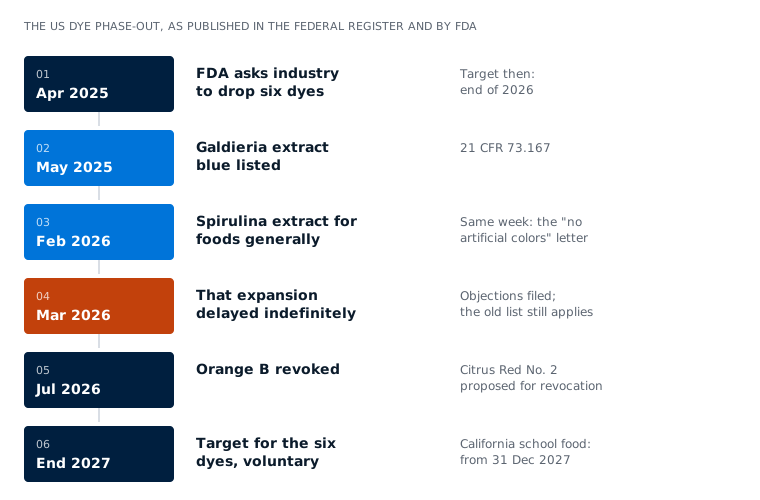
On 22 April 2025 the FDA and HHS announced a plan to phase out petroleum-based synthetic dyes. The six certified colours still in wide use, Green No. 3, Red No. 40, Yellow No. 5, Yellow No. 6, Blue No. 1 and Blue No. 2, were to be gone by the end of 2026. Citrus Red No. 2 and Orange B were to be revoked. Approval of natural alternatives was to be sped up, and companies were asked to drop Red No. 3 before the deadline that already applied to it.
The FDA page that tracks company pledges now gives a different year. As of its 15 September 2026 update, the agency is working with manufacturers to eliminate the six by the end of 2027. The same page lists the natural colours approved since the announcement: calcium phosphate, galdieria extract blue, gardenia blue, butterfly pea flower extract and beetroot red.
Blue No. 1 is still a listed colour additive. 21 CFR 74.101 has not been touched, and the phase-out is a request to industry. The one synthetic colour delisted on safety grounds in this period is Red No. 3, which the FDA revoked in January 2025, on cancer data in male rats, with the food listing coming off on 15 January 2027 and the ingested drug listing a year later.
The revocations that did go through are small. The FDA revoked the Orange B listing on 23 July 2026, effective 8 September, on the finding that the use had been abandoned, and proposed the same for Citrus Red No. 2 the same day.
The dates that do bind come from the states. California's AB 2316 takes Blue 1, Blue 2, Green 3, Red 40, Yellow 5 and Yellow 6 out of food served in public schools from 31 December 2027. West Virginia went further with HB 2354, a sales ban on the same dyes from 1 January 2028, and a federal judge blocked enforcement in December 2025 in a suit brought by the colour manufacturers' association. For a brand that sells into school food, the California date is the real deadline. For everyone else the deadline is the customer.
What spirulina extract is, in US law
The FDA does not treat spirulina extract as an ingredient with a colouring effect, which is the European route. Any substance added to give colour is a colour additive, and, as the FDA restated in its February 2026 order, there is no GRAS exception for colour additives. Spirulina extract is listed in 21 CFR 73.530 as a colour additive exempt from certification, which means no batch goes to the FDA for testing before it is sold, the way every lot of Blue No. 1 does.
The regulation defines it narrowly. It is made by filtered aqueous extraction of the dried biomass of Arthrospira platensis, and phycocyanins are its principal colouring components. It must carry no more than 2 mg/kg lead, 2 mg/kg arsenic and 1 mg/kg mercury, and it must test negative for microcystin.
Where you can use it today
The list in paragraph (c) is long because it was built one petition at a time. Mars got candy and chewing gum in 2013. GNT added frostings, ice cream, yogurt, puddings, beverage mixes and more in 2014. Colorcon added coatings for supplement and drug tablets in 2015, McCormick the seasonal colouring of hard boiled eggs in 2017, and GNT again added non-alcoholic beverages, alcoholic beverages under 20% ABV, sauces, dips and dairy alternatives in 2022.
The text in force reads: confections including candy and chewing gum, frostings, ice cream and frozen desserts including non-dairy, dessert coatings and toppings, beverage mixes and powders, yogurts and non-dairy yogurt alternatives, custards, puddings, cottage cheese, gelatin, breadcrumbs, ready-to-eat cereals other than extruded ones, alcoholic beverages under 20% ABV, non-alcoholic beverages, unheated seasoning mixes, salad dressings, condiments and sauces, dips, coatings on dietary supplement tablets and capsules, and egg shells. All at good manufacturing practice, which means no numeric cap, and never in a food with a standard of identity unless that standard allows added colour.
Read the list for what is missing. Baked goods, snack chips and crackers, extruded cereals and heated seasonings are not on it. A blue frosting on a cookie is covered; a blue cookie dough is not.
The expansion that is signed and on hold
On 6 February 2026 the FDA published a final order extending spirulina extract to human foods generally, on a petition from GNT, with three exclusions: meat, poultry and egg products under USDA jurisdiction, infant formula, and standardised foods. The same order tightened the specification to 0.2 mg/kg lead, 0.3 mg/kg arsenic and 0.1 mg/kg mercury, and added cadmium at 0.3 mg/kg. It was due to take effect on 23 March.
It did not. One company filed objections and a hearing request on 7 March, and under the statute that alone suspends the order. On 24 March the FDA delayed the effective date indefinitely, and said in the same notice that the delay does not change its finding of a reasonable certainty of no harm. Nothing further on spirulina extract has appeared in the Federal Register since. Beetroot red, approved the same week for foods generally, was delayed the same way.
There is no published timetable for resolving objections. The one recent data point is Red No. 3: the revocation order of January 2025 had its objections answered and its stay lifted on 5 August 2026, about nineteen months later. Plan on the old list.
What goes on the label
21 CFR 101.22(k)(2) gives three ways to declare a colour additive that is exempt from certification in the ingredient statement: "Color Added" or an equally informative term, "Colored with spirulina extract", or "spirulina extract color". The last two name the source, which is usually the point of the switch.
The front of the pack changed in February. Until then the FDA's position was that a product with any added colour could not claim "no artificial colors". On 5 February 2026 the agency announced enforcement discretion: the claim can now appear on products that contain no petroleum-based colours, even when they contain colour additives from natural sources. This is a policy on enforcement, set out in a letter to industry. The regulation underneath it, which still defines artificial colour as any colour additive, has not changed.
If the colour arrives as a blend, the carrier matters too. 21 CFR 73.1 allows diluents in exempt colour mixtures if they are GRAS or are listed in that section, so ask what the carrier is and on what basis it qualifies.
The other blues on the list
Spirulina extract is no longer the only natural blue with a US listing. Galdieria extract blue was listed in May 2025 under 21 CFR 73.167, for beverages, dairy drinks, candy, frozen desserts and a list of other categories. It is also a phycocyanin, from a red alga rather than a cyanobacterium, and why that matters in acid is the subject of our article on galdieria and spirulina phycocyanin. Butterfly pea flower extract was extended the same month to cereals, crackers, pretzels and chips, which are the snack categories spirulina extract cannot enter today, and gardenia blue was listed in July 2025. How the four compare on pH, heat and light is in our comparison of natural blues.
What to do now
Sort the portfolio against paragraph (c) as it reads today. A beverage, a gummy, a frosting or an ice cream can move to spirulina extract this quarter. A cracker or a baked good either waits for the expansion or uses a blue that is listed for it.
Check every SKU for a standard of identity before anything else, because the exclusion applies under the old list and the new one.
Ask your supplier for a certificate of analysis that reports lead, arsenic, mercury and cadmium against 0.2, 0.3, 0.1 and 0.3 mg/kg, the limits in the February order. They are not in force. They are where the regulation is going, and a lot that meets them now will not need requalifying later.
Write the label against 101.22 and decide whether to use the "no artificial colors" claim, knowing that it rests on enforcement discretion.
Then do the technical work, which no regulation shortens. Phycocyanin is a protein, so the process window and the pH floor decide more launches than the law does. Our guide to replacing Brilliant Blue FCF covers dose, shade and heat, and the low pH article covers acid.
TintBlue E18 and E40 are spirulina extract from Arthrospira platensis, and the certificate of analysis for the lot comes in the box. E18 is specified from pH 4.0 to 7.5 and takes pasteurisation at 72 °C for a short hold, not UHT or retort. The 30 g sample colours 10 to 60 kg of finished product, which is enough to run your matrix and settle the label question on the same lot. Everything else we know about the molecule is on the phycocyanin page.
Sources
- FDA. HHS, FDA to phase out petroleum-based synthetic dyes in nation's food supply, 22 April 2025
- FDA. Tracking food industry pledges to remove petroleum-based food dyes, content current as of 15 September 2026
- FDA. FDA takes new approach to "no artificial colors" claims, 5 February 2026
- 21 CFR 73.530, 73.1, 74.101 and 101.22, eCFR
- Federal Register. 91 FR 5291, 6 February 2026, and 91 FR 13966, 24 March 2026, spirulina extract
- Federal Register. 90 FR 20104, 12 May 2025, galdieria extract blue
- Federal Register. Orange B revocation, 23 July 2026
- California AB 2316, chaptered 28 September 2024; West Virginia HB 2354, 2025
This article describes the framework as published on 4 October 2026 and is not regulatory advice for a specific product. The European side of the same question is in spirulina extract in the EU.

