
A powdered drink mix is the easiest place to store phycocyanin and the hardest place to judge it. The protein sits dry in a sachet for months, which it tolerates well. Then the customer makes the product, with water at whatever temperature they have, at the dilution they choose, and with the acid you put in the mix. The formula has to be designed for the glass.
Dry is where the protein keeps
Oh and colleagues stored dried laver, a seaweed that carries phycocyanin, at water activities from 0.112 to 0.890, in the dark at 40 °C for 15 days. The pigments degraded faster as water activity rose, and water activity moved phycocyanin more than it moved phycoerythrin or the carotenoids, in their study of water activity and pigments in dried laver. Faieta and colleagues found the same link in solution: the activation energy of phycocyanin colour loss tracked the water activity, in their work on saccharides and phycocyanin.
So keep the blend dry. TintBlue E18 ships at 7.0% moisture or less and E40 at 5.0% or less. Our sealed powder sachet projects 90% colour retention at 18 months, and E18 is stored at 25 °C or below. A humid ingredient in the blend, or a pack that lets water in, spends that margin.
Dose for the glass, not for the powder
The use level on the data sheet, 0.05 to 0.30% w/w for E18, is a percentage of the finished drink. A mix is diluted, so the colour in the powder has to be worked back from the colour in the glass.
Take our ready to drink reference, 1.2 g of E18 per litre at pH 4.5. A 10 g stick made up to 500 mL needs 0.6 g of E18 to reach that shade, which is 6% of the stick. E40 goes in at about one third of the E18 dose, so the same blue takes 0.20 g, 2.0% of the stick. A 30 g protein serving made up to 300 mL needs 0.36 g of E18 for the same target, 1.2% of the powder.
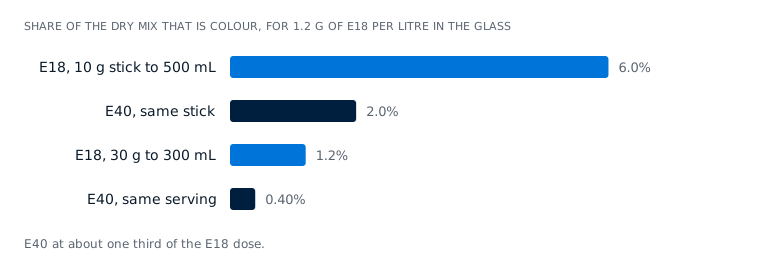
The dry blend will not look like the drink. Judge colour in the made up product, at the dilution printed on the label.
The acid arrives with the water
Most sports and electrolyte mixes carry citric acid, and the pH that matters is the reconstituted drink's. Phycocyanin is not harmed by mild acid as such: Patel and colleagues measured denaturation at 65 °C about five times slower at pH 5 than at pH 7, in their study of thermal denaturation kinetics. What it needs is a floor. TintBlue E18 is specified from pH 4.0 to 7.5 and is kept above pH 3.5 at all times; E40 is specified from pH 4.5. Lower down the clock runs faster: Brauch and colleagues measured a half life of 70 days for spirulina blue in solution at pH 3.6, in their comparison of blue colorants.
Measure the pH of the drink at the label dilution, and again at the strongest mix a customer is likely to make, since less water means a higher concentration of acid. If it reads below 4.0, replace part of the citric acid with sodium citrate, or move the tartness to a less acidic flavour system. The low pH article has the kinetics.
A hot drink is a heat step
A mix sold for hot milk or hot water puts the pigment through heat in the cup. Faieta and colleagues found C-phycocyanin stable at 45 °C over their experiment and mostly gone within ten minutes at 80 °C, in their study of isothermal and dynamic thermal degradation. Water from the kettle is well above 80 °C. Either design the product as a cold drink, or print preparation instructions that keep the cup warm rather than hot, and test it the way the label says to make it.
Getting a small ingredient even
At 1 to 6% of the blend the colour is a minor ingredient, and a minor ingredient that is not spread evenly shows up as one deep blue glass and one pale one. Premix the colour with a portion of the sugar or bulking base first, then add that premix to the main blend. Match particle size where you can: E18 is 250 µm or finer and E40 is 200 µm or finer. E40 is hygroscopic, so weigh it in the driest room you have and reseal the bag at once. Both grades keep for three months after opening if resealed.
Pack and label
A foil stick or sachet is opaque and keeps light out. A clear tub on a lit shelf does not: Brauch and colleagues measured a half life of about four days for spirulina blue in clear gelatin gels under light, in the same comparison. The powder is less exposed than a gel, but the risk is the same in kind. The light article has the numbers.
In the US, paragraph (c) of 21 CFR 73.530 lists beverage mixes and powders, and puddings, among the permitted uses of spirulina extract. A dry mix for a baked product, such as a cake mix, is not covered, because baked goods are not on the list. Our US article follows the list and the expansion that is on hold; the EU article covers colouring food status.
When it goes wrong
| What you see | Likely cause | What to change |
|---|---|---|
| Drink fades in the fridge within days | Reconstituted pH below 4.0 | Measure at label dilution, swap part of the acid for sodium citrate |
| Blue gone from a hot serve | Made with kettle water | Cold or warm preparation, and say so on the pack |
| Colour varies from stick to stick | Colour not premixed, or particle sizes far apart | Premix with part of the base, match particle size |
| Caked or darkened powder in the tub | Moisture getting in | Drier ingredients, a better barrier, reseal |
| Faded powder at the front of the shelf | Clear pack under light | Foil or opaque pack |
Starting doses
Calculated from our reference doses: 1.2 g per litre for a pH 4.5 drink, and 1.0 g per litre for a milk drink, the drinking yogurt reference. E40 is about one third of the E18 dose. These are where we would start a bench trial, not finished formulas.
| Format | Serving | E18 per serving | E40 per serving |
|---|---|---|---|
| Electrolyte or sports stick, buffered to pH 4.0 or above | 10 g into 500 mL water | 0.60 g, 6.0% of the stick | 0.20 g, 2.0% |
| Protein or smoothie powder, neutral | 30 g into 300 mL milk | 0.30 g, 1.0% of the powder | 0.10 g, 0.33% |
| Instant pudding or dessert mix, made cold | 100 g into 500 mL milk | 0.50 g, 0.5% of the mix | 0.17 g, 0.17% |
Which grade does which job
E18 sits on a trehalose carrier that disperses in cold water, which is what a customer shaking a bottle needs, and it flows in a dry blend. It is specified down to pH 4.0, so it is the grade for an acid sports drink. E40 has no carrier and puts the same blue in at about a third of the E18 dose. That is its job in a small stick where every gram is already taken by electrolytes, sweetener and flavour. It is specified from pH 4.5 and is hygroscopic, which makes it a good fit for a neutral protein or milk mix packed in foil.
A free 30 g sample of TintBlue E18 colours 50 sticks at 0.6 g. The 10 g sample of TintBlue E40 colours 50 at 0.20 g. Request a sample, and if the mix is replacing a synthetic blue, the Brilliant Blue replacement guide covers the dose and label changes.
Sources
According to PubMed and the regulatory record:
- Oh S, Shin M, Lee K, Choe E. Effects of water activity on pigments in dried laver (Porphyra) during storage. Food Sci Biotechnol, 2013. 10.1007/s10068-013-0247-x
- Faieta M, Neri L, Sacchetti G, Di Michele A, Pittia P. Role of saccharides on thermal stability of phycocyanin in aqueous solutions. Food Res Int, 2020. 10.1016/j.foodres.2020.109093
- Patel A, Pawar R, Mishra S, Sonawane S, Ghosh PK. Kinetic studies on thermal denaturation of C-phycocyanin. Indian J Biochem Biophys, 2004. PubMed 22900283
- Brauch JE, Zapata-Porras SP, Buchweitz M, Aschoff JK, Carle R. Jagua blue derived from Genipa americana L. fruit: a natural alternative to commonly used blue food colorants? Food Res Int, 2016. 10.1016/j.foodres.2016.08.029
- Faieta M, Toong C, Corradini MG, Ludescher RD, Pittia P. Degradation kinetics of C-Phycocyanin under isothermal and dynamic thermal treatments. Food Chem, 2022. 10.1016/j.foodchem.2022.132266
- 21 CFR 73.530, Spirulina extract, paragraph (c), as in force on 1 October 2026. eCFR
The reference doses, moisture, particle size, pH ranges, storage and sachet retention figures are from the data sheets for TintBlue E18 and TintBlue E40.

