
Most of what we write about phycocyanin is about keeping a protein folded in water: a drink, a yogurt, a frosting. Honey has very little water to unfold it in. It is around four fifths sugar, it is never cooked, and it is made to keep. Those three facts are why blue honey made with spirulina extract holds its colour, and the same three facts, turned around, are how it fails.
| The question | The short answer |
|---|---|
| Why it holds | Low water activity, a sugar concentration that keeps the protein in its native fold, and no heat step after the colour goes in |
| The dose | TintBlue E18 at 0.05 to 0.30% w/w, or E40 at a third of that, mixed dry into part of the batch instead of predissolved in water |
| What breaks it | Heating the coloured honey above about 60 °C, a clear jar in sunlight, and syrups acidified below pH 4 |
| What the label says | In the US and the EU the jar can no longer be called just "honey". The colour is declared as spirulina extract |
Why the blue holds in honey
There is almost no free water. Water activity measures how much of the water in a food is free to take part in reactions, from 0 for dry to 1 for pure water. Rosiak and colleagues measured 40 honeys from Poland and Thailand and found water activity between 0.501 and 0.578 in the Polish samples and 0.553 to 0.673 in the Thai ones, in their study of honeys from two climate zones. A drink sits close to 1. Phycocyanin loses its colour when the protein unfolds, and unfolding happens in water. Faieta and colleagues heated spirulina extract in water and in sucrose and trehalose solutions and found colour loss fell as the sugar concentration rose, and the activation energy of the colour loss tracked the water activity of the solution, in their study of saccharides and thermal stability. Honey is the far end of that series.
The sugar holds the fold. Honey's sugar is mostly fructose and glucose. Huo and colleagues heated food grade phycocyanin for an hour at 65 °C with and without sugars. With 40% glucose, 73.6% of it was still there; without any sugar, under a third was, and the protection rose with the sugar concentration, in their study of saccharides and sugar alcohols. The same mechanism is why the pigment survives a hot gummy deposit, which the gummies article covers. A honey carries roughly twice the sugar of the 40% glucose solution in Huo's study.
Nothing heats it afterwards. A drink is pasteurised after the colour goes in and a gummy is deposited hot. A honey is warmed, if at all, to make it flow, and that warming can happen before the colour is added. The pigment then spends its life at room temperature in a medium that slows the reactions that destroy it.
The pH is the one number to watch. Honey is acidic. Rosiak's Polish honeys measured pH 3.38 to 4.43 and the Thai ones 3.44 to 4.90, read on 10 g of honey dissolved in 75 mL of water. That puts many honeys at or under the 4.0 floor of our specification. That floor was set for drinks and other watery products, where acid acts on a protein surrounded by water, and in the jar there is little water for it to act through. We have not found a study that measures phycocyanin across honeys of different pH, so treat honey pH as something to measure, prefer the higher pH honeys when you have a choice, and let the shelf trial decide.
How much, and how to get it in
Our dose range for TintBlue E18 is 0.05 to 0.30% w/w of finished product, 0.5 to 3 g per kilo. E40 delivers the same blue at about a third of the E18 dose. Where a honey lands in that range depends less on the pigment than on the honey.
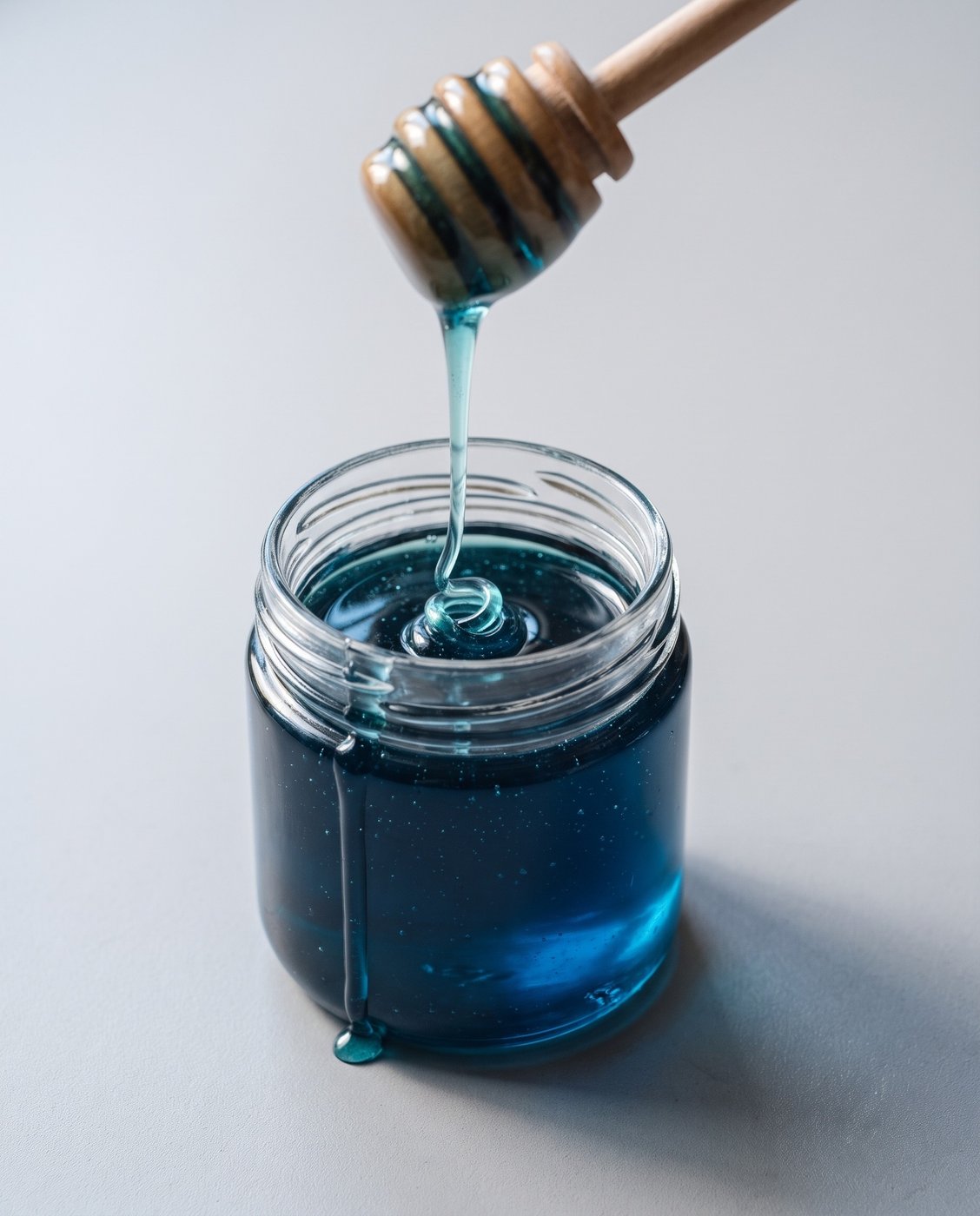
The honey's own colour decides the shade. Honey runs from water white to dark amber, and amber plus blue is green. A pale honey gives a clean blue; an amber one gives teal, and a dark one drifts toward olive. Pick the palest honey you can source before you touch the dose, and judge the colour in the jar you will sell it in: a full jar reads deep, the ribbon off a spoon reads turquoise, and a creamed or crystallised honey reads pastel because the crystals scatter light. A ladder at 0.05, 0.10 and 0.20% in the real honey settles the shade in an afternoon.
Do not add water to get it in. Our usual instruction for every other format is a 5 to 10% premix in cold water. In honey that instruction works against you. A 10% premix at a 0.10% dose adds about 0.9 g of water per 100 g of honey, and water is the one thing honey is protected by not having. Rosiak and colleagues put the limit for osmotolerant yeasts at a water activity of about 0.61 to 0.62, and in their Thai samples the honeys with more water carried more yeasts and moulds. Mix the powder dry into a tenth of the batch, stir slowly until it is even and free of air, let it stand until the specks have dissolved, then fold that masterbatch into the rest. If the line cannot work that way, dissolve the powder in the least water that works and count that water against the honey's moisture.
Syrups are a step closer to a drink. A sugar syrup or a flavoured syrup carries more water than honey, so it gets less of honey's protection and more of the beverage rules. If it is acidified, hold it at pH 4.0 or above with a citrate buffer rather than free citric acid. If it is diluted into a drink by the customer, the drink's pH is the one that counts.
What breaks it
Heating the coloured honey above about 60 °C. Our specification puts the point where colour loss rises at about 60 °C, and Huo's data agrees: the protection from sugar fell away sharply above 60 °C, and at 70 °C the samples with sugar were only slightly better than the ones without. Decrystallise, filter and warm the honey before the pigment goes in. Add the colour at the lowest temperature at which the honey still flows, and do not warm the coloured batch again.
A clear jar in sunlight. Phycocyanin is a light harvesting protein, and in a clear container under light it keeps harvesting with nowhere to send the energy. In clear gelatin gels, Brauch and colleagues measured a half life of 4 days for spirulina blue under illumination, in their comparison of blue colorants. Honey is sold in clear glass because people want to see it. Keep the clear jar and add protection around it: a carton, a full wrap label, UV blocking glass, or a shelf out of the window. A jar kept in a dark cupboard at home is the kind of storage this pigment likes. The article on light and packaging has the half lives by condition.
Acidic syrups under pH 4. A lemon or berry syrup acidified to pH 3 with free citric acid is a drink concentrate with the water a drink has. Below pH 4.0 the protein begins to unfold and below 3.5 the colour goes for good. Patel and colleagues measured the protein about five times more stable at pH 5 than at pH 7 at 65 °C, in their study of thermal denaturation kinetics, so the damage comes from strong acid, below the window. What breaks the blue at low pH has the detail, and the comparison with Galdieria phycocyanin covers what to use below the window.
What the label says
United States. FDA guidance on the proper labeling of honey and honey products says a product made of honey and another ingredient cannot carry the name "honey" alone; its name has to describe what it is. The ingredient statement then lists honey and the colour, which 21 CFR 101.22(k)(2) lets you write as "spirulina extract color" or "colored with spirulina extract". The harder question is the category. The list of uses in 21 CFR 73.530 names dessert coatings and toppings, condiments and sauces, non-alcoholic beverages and beverage mixes, and does not name honey. A pancake or dessert syrup reads most naturally as a topping; a coloured honey spread is a call between condiment and topping that belongs to your regulatory counsel. The order extending spirulina extract to foods generally would settle it and is on hold, as our US article explains. Of the natural blues, jagua is the one whose US listing names syrups outright.
European Union. Council Directive 2001/110/EC reserves the name "honey" for honey and says that honey placed on the market as honey can have nothing added to it. A blue honey is therefore a different food, sold under a descriptive name that does not present it as honey, with honey and spirulina extract in the ingredient list. Spirulina extract itself is a colouring food in the EU, with no E number, and our EU article covers the file that supports that. How far the word honey can appear in the product name is a question for the authority of the country where you launch.
Where to go from here
The food and beverage grade is TintBlue E18, and the Color line page has both grades with their stability data. The sample is 30 g of E18, which at 0.05 to 0.30% colours 10 to 60 kg of honey, enough for a dose ladder in your palest and your darkest honey and a shelf trial in the jar you sell. It ships with the certificate of analysis for the lot you receive.
Sources
According to PubMed:
- Rosiak E, Madras-Majewska B, Teper D, Łepecka A, Zielińska D. Cluster analysis classification of honey from two different climatic zones based on selected physicochemical and of microbiological parameters. Molecules, 2021. 10.3390/molecules26082361
- Faieta M, Neri L, Sacchetti G, Di Michele A, Pittia P. Role of saccharides on thermal stability of phycocyanin in aqueous solutions. Food Res Int, 2020. 10.1016/j.foodres.2020.109093
- Huo Y, Hou X, Yu Y, Wen X, Ding Y, Li Y, Wang Z. Improving the thermal and oxidative stability of food-grade phycocyanin from Arthrospira platensis by addition of saccharides and sugar alcohols. Foods, 2022. 10.3390/foods11121752
- Brauch JE, Zapata-Porras SP, Buchweitz M, Aschoff JK, Carle R. Jagua blue derived from Genipa americana L. fruit: a natural alternative to commonly used blue food colorants? Food Res Int, 2016. 10.1016/j.foodres.2016.08.029
- Patel A, Pawar R, Mishra S, Sonawane S, Ghosh PK. Kinetic studies on thermal denaturation of C-phycocyanin. Indian J Biochem Biophys, 2004. PubMed 22900283
Regulatory sources:
- US Food and Drug Administration. Proper Labeling of Honey and Honey Products: Guidance for Industry, 2018
- US Code of Federal Regulations, 21 CFR 73.530 and 101.22
- Council Directive 2001/110/EC relating to honey, consolidated text
The dose ranges, the 60 °C limit and the pH window are ours, from the specifications and application guides for TintBlue E18 and TintBlue E40.

