
Blue is the colour the natural palette struggles with. Reds come from anthocyanins and beet, yellows from curcumin and carotenoids, greens from chlorophyll, and all of them have decades of industrial use behind them. Blue had one option for a long time, and it was synthetic. Today there are four natural candidates. We sell one of them, so read this with that in mind, and check every number against its paper.
The four molecules
Spirulina extract is phycocyanin, a protein from Arthrospira platensis carrying a phycocyanobilin chromophore. Water soluble, sky blue, no E number. It is a protein, and everything about its stability follows from that.
Jagua blue is made from the fruit of Genipa americana. Genipin in the fruit reacts with amino acids to form blue polymers. Water soluble, a slightly greener blue than spirulina, and a novel food in the European Union.
Gardenia blue is the same chemistry from a different plant, Gardenia jasminoides, and the same reaction of genipin with an amine. It has a long history in Japan and a shorter one in the West.
Butterfly pea is an anthocyanin extract from the flower of Clitoria ternatea, rich in polyacylated anthocyanins called ternatins. It is the only one of the four that is an anthocyanin, and that is both its strength and its problem.
Acid: where the anthocyanin moves and the protein holds
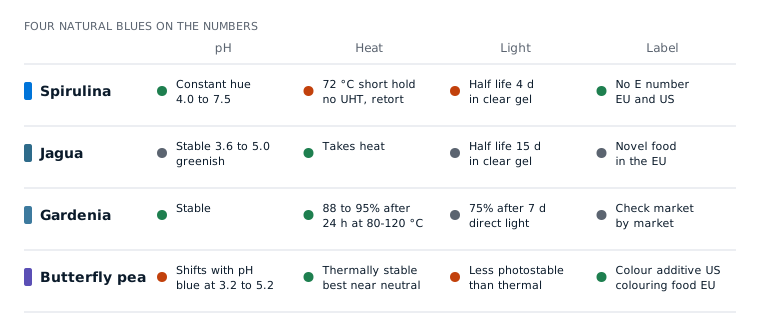
Anthocyanins change colour with pH. That is what they are. Escher and colleagues titrated butterfly pea extract across the range and recorded colour changes between pH 2.25 and 10.2, reversible, in their characterisation of butterfly pea anthocyanins. Fu and colleagues describe the same extract as magenta at pH 0.5, blue around neutral and blue green at pH 10, in their study of spectral characteristics and storage stability. Vidana Gamage and colleagues, reviewing the flower, put the intense blue window at pH 3.2 to 5.2, in their review of butterfly pea anthocyanins.
Phycocyanin holds its hue across the whole of its window. The colour at pH 4.0 and at pH 7.5 is the same blue, and the protein is in fact more stable in mild acid than at neutral pH, as Patel and colleagues measured in their denaturation kinetics across pH. Below pH 3.5 it unfolds, and that is a hard floor.
The genipin blues sit between the two. Brauch and colleagues found jagua's hue between pH 3.6 and 5.0 similar to indigo carmine, and stable there, in their assessment of jagua against spirulina and the synthetic blues.
For a product whose pH is fixed and inside 4.0 to 7.5, phycocyanin's constancy is the advantage. For a product that wants to shift colour with pH, butterfly pea is the only one that will.
Heat: the protein's weak point
This is where spirulina loses cleanly. Phycocyanin survives pasteurisation at 72 °C for a short hold and does not survive UHT or retort. The genipin pigments are small molecules and take heat. Gao and colleagues held a water insoluble gardenia blue at 80 to 120 °C for 24 hours and recovered 88 to 95% of it, in their characterisation of gardenia blue pigment. No protein does that. Butterfly pea anthocyanins are reported as thermally stable and more so near neutral pH than in strong acid, per Fu and colleagues above.
A retorted product, a UHT drink or a baked good coloured through the crumb is not a phycocyanin product. We say so on the data sheet rather than let a trial find out. For those, a genipin blue is the natural option.
Light: nobody wins, some lose faster
Under illumination, all four fade. The comparison that exists is Brauch and colleagues' gelatin gels: spirulina lost its blue with a half life of 4 days under light, jagua held for 15. Butterfly pea anthocyanins show less photostability than thermal stability, per the Vidana Gamage review, and Escher and colleagues needed fructooligosaccharides in the extract to slow photodegradation at pH 5.4. Gardenia blue in Gao's work kept 75% after 7 days under direct light.
So jagua and gardenia carry more light margin than spirulina, and none of them carry enough to go in a clear pack on a lit shelf without a study. Opaque packaging is the fix for all four, and it is required for ours.
Shelf life in solution
Brauch and colleagues measured storage half lives at pH 3.6: spirulina 70 days, jagua 86 to 105 days, indigo carmine 9 or fewer. At the acid end of the window jagua has the edge. Our own retention data for the food grade sits higher, because we measure it in a beverage matrix rather than a buffer and at pH 4.5 rather than 3.6: 85% at 12 months ambient, 92% at pH 4.0 held cold. A matrix with sugar in it protects the protein, which a buffer does not, and the number a formulator should plan around is the one measured in something like their product.
Label and regulation
Spirulina extract has no E number in the European Union, where it is a colouring food under Regulation 1333/2008, and is spirulina extract (color) under 21 CFR 73.530 in the United States. Jagua and gardenia are newer to the Western regulatory framework and their status should be checked market by market before a launch is planned around them. Butterfly pea is listed in the United States as a colour additive and its anthocyanins are colouring foods in the EU. None of the four carry the warning sentence that the Southampton trial put on six synthetic colours, which is the reason most brands are here in the first place; that trial is in the Lancet paper on food additives and hyperactive behaviour.
Hue, and the violet nobody mentions
Spirulina is the cleanest sky blue of the four. Jagua and gardenia lean green. Butterfly pea at pH 4 to 5 is a deeper, slightly violet blue. If the brief is a violet or a purple, phycocyanin's sibling allophycocyanin holds a true violet that does not swing with pH, which is the one thing an anthocyanin purple cannot do, and it is the basis of our TintPurple grade in development.
Which to choose
For a beverage, dairy, confectionery, ice cream or supplement at pH 4.0 to 7.5 that is pasteurised or cold filled, spirulina extract is the cheapest blue per colour unit, the cleanest label, and the one with the longest application history. For anything retorted, UHT or baked through, use a genipin blue and budget for its regulatory file. For a colour changing product, butterfly pea. For a violet that holds, allophycocyanin. And for all of them, pack opaque and run the study in the product, not in a buffer.
Sources
According to PubMed:
- Brauch JE, Zapata-Porras SP, Buchweitz M, Aschoff JK, Carle R. Jagua blue derived from Genipa americana L. fruit: a natural alternative to commonly used blue food colorants? Food Res Int, 2016. 10.1016/j.foodres.2016.08.029
- Gao Y, Xu J, Liu G, et al. Preparation and characterization of water-insoluble gardenia blue pigment. Materials, 2021. 10.3390/ma14216594
- Vidana Gamage GC, Lim YY, Choo WS. Anthocyanins from Clitoria ternatea flower: biosynthesis, extraction, stability, antioxidant activity, and applications. Front Plant Sci, 2021. 10.3389/fpls.2021.792303
- Fu X, Wu Q, Wang J, Chen Y, Zhu G, Zhu Z. Spectral characteristic, storage stability and antioxidant properties of anthocyanin extracts from flowers of butterfly pea. Molecules, 2021. 10.3390/molecules26227000
- Escher GB, Wen M, Zhang L, Rosso ND, Granato D. Phenolic composition by UHPLC-Q-TOF-MS/MS and stability of anthocyanins from Clitoria ternatea L. (butterfly pea) blue petals. Food Chem, 2020. 10.1016/j.foodchem.2020.127341
- Patel A, Pawar R, Mishra S, Sonawane S, Ghosh PK. Kinetic studies on thermal denaturation of C-phycocyanin. Indian J Biochem Biophys, 2004. PubMed 22900283
- McCann D, Barrett A, Cooper A, et al. Food additives and hyperactive behaviour in 3-year-old and 8/9-year-old children in the community: a randomised, double-blinded, placebo-controlled trial. Lancet, 2007. 10.1016/S0140-6736(07)61306-3
The spirulina retention figures are ours, from TintBlue E18, and the violet is TintPurple.


