
Ask why a spirulina blue failed in a beverage and the answer comes back the same way almost every time: the pH was too low. It is the first thing a supplier says and the first thing a formulator writes in the trial notes.
The kinetics do not support it.
The protein is more stable in acid, not less
Patel and colleagues measured the thermal denaturation of C-phycocyanin from Spirulina platensis across pH 4.0 to 8.0 and fitted first order rate constants. At 65 °C the denaturation rate was 1.46 × 10⁻⁴ s⁻¹ at pH 5.0 and 7.96 × 10⁻⁴ s⁻¹ at pH 7.0. The protein came apart roughly five times faster at neutral pH than in acid, and the entropy values pointed at the reason: a closer fitting structure at pH 5.0 that holds its shape at temperatures where the neutral form has already lost it. The work is in a study of denaturation kinetics across the pH range.
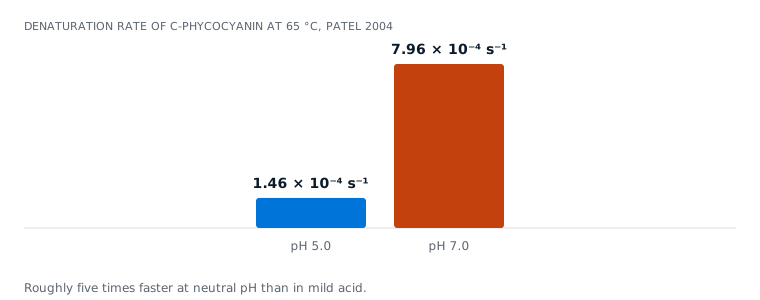
That is the opposite of the received wisdom, and it matters, because it means the acid in a soft drink is not the thing dismantling the protein.
What is actually happening is heat, and time
Faieta and colleagues held C-phycocyanin at fixed temperatures from 45 to 80 °C and watched it go. At 45 °C it was stable. At 80 °C less than ten minutes destroyed most of it. They also found that the colour loss did not track the chromophore alone: spectral shifts and a rise in anisotropy pointed at conformational change and aggregation of the protein subunits, which is to say the blue can go while the pigment is still chemically there. The measurements and the model are in their work on isothermal and dynamic thermal degradation.
This is the part that catches people out in a pilot. A bench trial at room temperature says the colour holds. The same formula through a heat step says it does not, and the pH never changed.
Our own numbers say the same thing
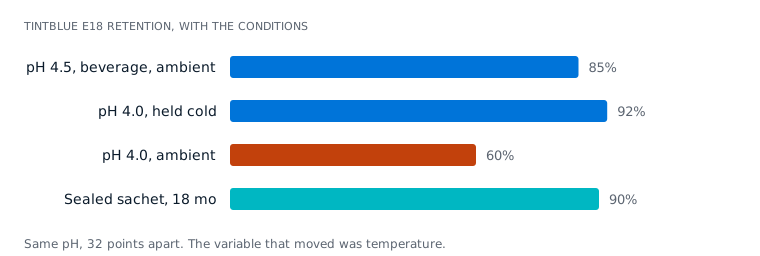
We publish retention with its conditions attached, which is the only way a retention figure means anything. Three of them for TintBlue E18:
| Condition | Retention |
|---|---|
| pH 4.5, beverage matrix, ambient | 85% at 12 months |
| pH 4.0, held cold | 92% |
| pH 4.0, ambient | 60% |
Read the last two together. Same pH, same product, 32 points apart. The variable that moved was temperature.
That is why our specification runs from pH 4.0 and why it says to keep the product above pH 3.5 at all times. Below that the protein does come apart, and no amount of cold storage saves it. Between 4.0 and 7.5 the question a formulator should be asking is not what the pH is. It is how hot the product gets, for how long, and how warm it sits afterwards.
Where the heat step is survivable and where it is not
Pasteurisation at 72 °C for a short hold is survivable, and we sell against it. UHT and retort are not, and we say so rather than let somebody find out in a production run. The Faieta curve explains why: the damage at 80 °C is done in minutes, so a process that spends seconds at temperature is a different proposition from one that spends a quarter of an hour.
Two other levers are worth knowing about, because they show up in the literature and in sales conversations.
Organic acids raise the half life. Gomaa and colleagues found that citric acid at 7.5 mM took the half life of phycocyanin from 71.8 minutes to 189.4 minutes, and reported the thermodynamics behind it, in work on stabilising phycocyanin with organic acids. If your matrix is already acidified, some of that protection is there for free.
The source organism matters. Phycocyanin from a thermophilic cyanobacterium had roughly twelve times the half life of the mesophilic equivalent at 60 °C and pH 7, according to a comparison of thermophilic and mesophilic strains. That is a research direction rather than a product today, and anyone selling it as one should be asked for the lot data.
The shelf is a slower version of the same problem
Storage is heat with the volume turned down and the clock turned up. Brauch and colleagues tracked spirulina blue in solution at pH 3.6 and measured a half life of 70 days, against 86 to 105 days for a jagua comparison, and in coloured gelatin gels the spirulina lost out on light stability at 4 days against 15. The comparison is in their assessment of blue colorants against synthetic references.
We would rather quote our own matrix data than a model solution, which is why the table above is a beverage and not a buffer. But the shape of the curve is the same everywhere: warm and lit is the enemy, and cold and dark buys months.
What to do with this
If you are designing a trial, stop varying pH first. Fix the pH where your product needs it, between 4.0 and 7.5, and vary the thermal profile and the storage temperature instead. That is where the retention moves.
If you are troubleshooting a fade, ask three questions in this order. How hot did it get and for how long. How warm has it been sitting since. What is the light exposure on the shelf. The pH is the fourth question, not the first, and if it is above 3.5 it is probably not your problem.
And if you want the numbers on your own matrix rather than ours, the sample is free and sized to run the test: 30 g of E18 colours 10 to 60 kg of finished product at typical use levels.
Sources
According to PubMed:
- Patel A, Pawar R, Mishra S, Sonawane S, Ghosh PK. Kinetic studies on thermal denaturation of C-phycocyanin. Indian J Biochem Biophys, 2004. PubMed 22900283
- Faieta M, Toong C, Corradini MG, Ludescher RD, Pittia P. Degradation kinetics of C-Phycocyanin under isothermal and dynamic thermal treatments. Food Chem, 2022. 10.1016/j.foodchem.2022.132266
- Gomaa M, Ali SA, Hifney AF. Enhancement of phycocyanin productivity and thermostability from Arthrospira platensis using organic acids. Microb Cell Fact, 2023. 10.1186/s12934-023-02256-2
- Chittapun S, Suwanmanee K, Kongsinkaew C, Pornpukdeewattana S, Chisti Y, Charoenrat T. Thermal degradation kinetics and purification of C-phycocyanin from thermophilic and mesophilic cyanobacteria. J Biotechnol, 2024. 10.1016/j.jbiotec.2024.11.018
- Brauch JE, Zapata-Porras SP, Buchweitz M, Aschoff JK, Carle R. Jagua blue derived from Genipa americana L. fruit: a natural alternative to commonly used blue food colorants? Food Res Int, 2016. 10.1016/j.foodres.2016.08.029
Retention figures for TintBlue E18 are ours, measured on our own material, and the conditions are printed beside every one of them on the product page.

