
Phycocyanin arrives in a cosmetic brief with three things attached: a colour, an antioxidant story and a photoprotection story. The colour is real and needs no study. The other two have studies, and the studies are narrower than the marketing. This is what they measured.
The antioxidant result, and the catch
Puglisi and colleagues took a commercial food grade phycocyanin and a laboratory fraction they extracted themselves, and put both on human fibroblasts and keratinocytes under two kinds of stress: a chemical oxidant and UVA light. The commercial material lowered reactive oxygen species in both cell lines after the chemical challenge and after UVA, with the effect on keratinocytes lasting through 25 minutes of exposure. The laboratory fraction did not protect the cells. It did the opposite, showing a significant pro-oxidant effect. The commercial material had a purity ratio of 2.0 and the fraction 1.5, and the ORAC values ran the other way, 12,141 against 32,680 Trolox equivalents per 100 g. The work is in their study of antioxidant activity on human skin cells.
Read that twice. A higher antioxidant capacity in the tube produced a worse result on the cells, and the purer, gentler material protected them. The lesson for a formulator is that an ORAC number on a data sheet is not a skin claim, and that what else is in the extract decides the outcome. Purity ratio, A620 over A280, is a number to ask for, and a cell study on the actual grade is the only thing that settles it.
The UVB result
Jang and Kim exposed HaCaT keratinocytes to UVB and measured what C-phycocyanin did to the damage. Cell survival after UVB rose from 50.8% to 80.3% with the protein present. The matrix metalloproteinases MMP-1 and MMP-9, which UVB drives up and which degrade collagen, came down. The barrier proteins involucrin, filaggrin and loricrin, which UVB pushes down, rose by more than 25% at 80 µg/mL. Reactive oxygen species fell by 51% and 55% at 40 and 80 µg/mL. No toxicity was seen between 5 and 80 µg/mL. The paper is their study of protection against UVB damage in HaCaT cells.
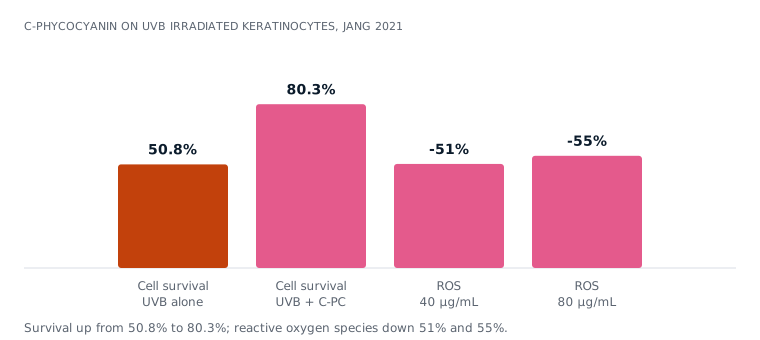
That is a clean in vitro result on the right cell type at cosmetic concentrations, and it supports a defence against light induced free radicals claim. It does not support a sun protection claim, and the next paper is why the distinction matters.
Where the SPF idea comes from, and why it is not a claim
Favas and colleagues screened four cyanobacteria for anti-ageing activity and correlated the chemistry of the extracts with the assays. Their principal component analysis linked phycocyanin and allophycocyanin content with UVB blocking in the SPF assay, and one strain reached an in vitro SPF of 19 at 200 µg/mL, in their survey of cyanobacterial metabolites for anti-ageing cosmetics.
It is a real signal and an interesting one. It is also an in vitro SPF on a crude extract of a different organism at a high concentration, and an SPF on a label is a regulated measurement on human skin under a defined protocol. Phycocyanin is not a sunscreen filter in any market's positive list. The claim that survives legal review is antioxidant defence against light induced free radicals, including blue light. The one that does not is anything that sounds like blocking, screening or an SPF equivalent, and we write that on our own data sheet so nobody has to learn it from a regulator.
Barrier and wound closure
Gunes and colleagues put an aqueous spirulina extract into a skin cream and tested it on keratinocytes. At 0.1% the extract raised proliferation to 198% of control after three days, a cream at 1.125% extract improved closure in a scratch wound assay, and the micronucleus test on human blood cells found no genotoxicity, in their evaluation of a spirulina extract skin cream. It is a crude extract rather than purified phycocyanin, and a scratch assay is not a barrier repair claim. Together with the involucrin and filaggrin result above it supports a barrier support positioning, which is as far as the data goes.
What this means for a formula
The concentrations in these studies are 5 to 200 µg/mL in cell culture. Our cosmetic grade is dosed at 0.05 to 0.5% in serums, 0.1 to 0.5% in oil in water creams and 0.2 to 1.0% in masks, which puts the active in the formula at 500 to 10,000 µg per mL of product, well above the range where the cell effects were seen and where Jang and Kim saw no toxicity. It goes into the water phase below 40 °C, above pH 4.5 with 5.5 or higher preferred, and it is a protein, so it wants an opaque or airless pack and a preservative system that does not attack it.
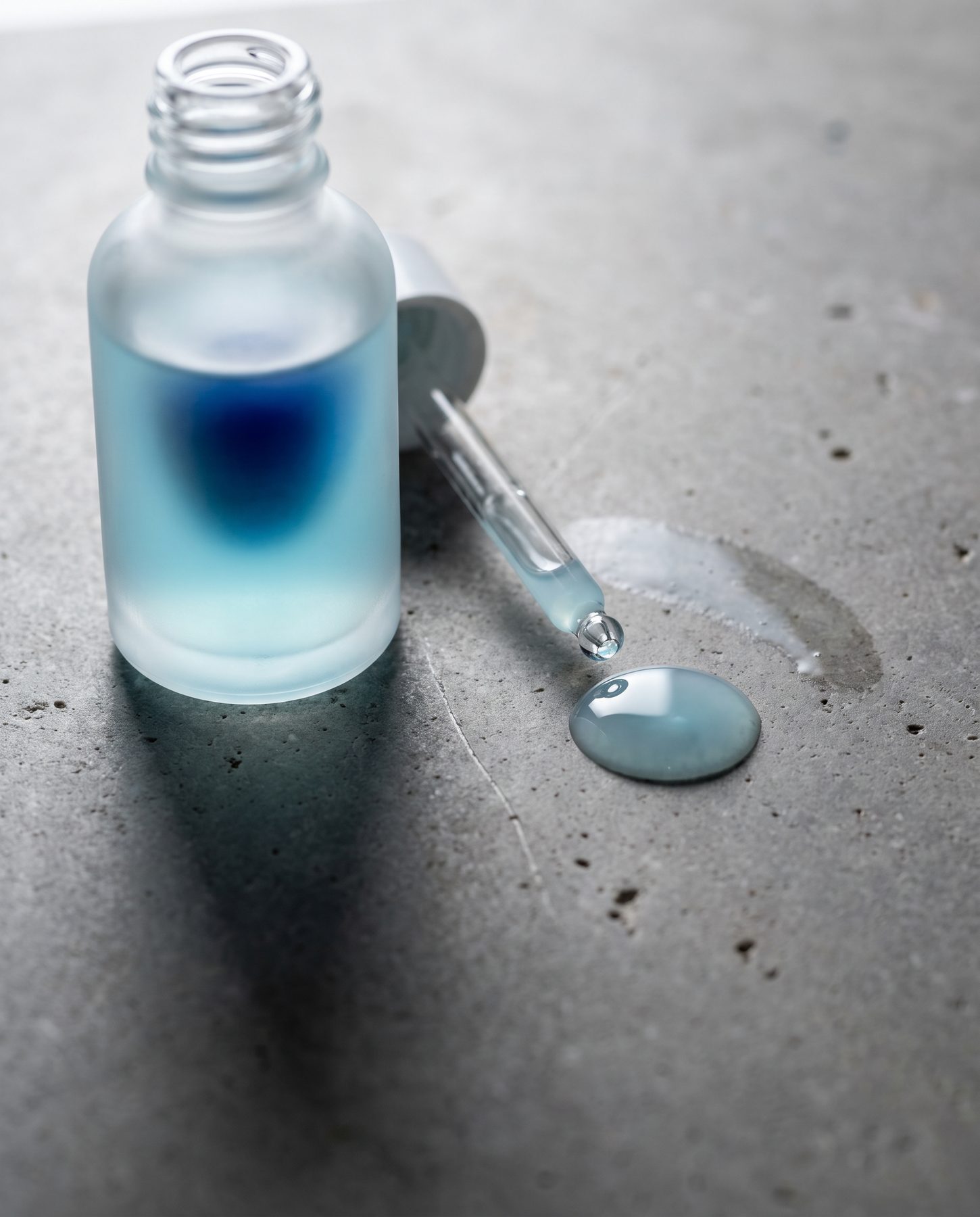
Colour is the other half. The active is the blue, so a serum at 0.3% is visibly blue and the shade is part of the claim. A pale wash at 0.05% is still active by the numbers above; it is a question of how much colour the brief wants.
What to ask a supplier
The purity ratio of the grade, on a certificate, not a data sheet. Whether the antioxidant number was measured on the grade you are buying or on something else. Whether there is any cell data on the material itself. And which claims they will support in writing, because a supplier who will put "SPF" in an email is a supplier whose material you will have to defend alone. Ours are brightening and antioxidant defence including against blue light induced free radicals, never blue light blocking, never an SPF equivalent, and the endpoint percentages are held for the proprietary topical clinical rather than rounded up from a cell study.
Sources
According to PubMed:
- Puglisi R, Biazzi E, Gesmundo D, Vanni R, Tava A, Cenadelli S. The antioxidant activity of a commercial and a fractionated phycocyanin on human skin cells in vitro. Molecules, 2022. 10.3390/molecules27165276
- Jang YA, Kim BA. Protective effect of spirulina-derived C-phycocyanin against ultraviolet B-induced damage in HaCaT cells. Medicina (Kaunas), 2021. 10.3390/medicina57030273
- Favas R, Morone J, Martins R, Vasconcelos V, Lopes G. Cyanobacteria secondary metabolites as biotechnological ingredients in natural anti-aging cosmetics: potential to overcome hyperpigmentation, loss of skin density and UV radiation-deleterious effects. Mar Drugs, 2022. 10.3390/md20030183
- Gunes S, Tamburaci S, Dalay MC, Deliloglu Gurhan I. In vitro evaluation of Spirulina platensis extract incorporated skin cream with its wound healing and antioxidant activities. Pharm Biol, 2017. 10.1080/13880209.2017.1331249
The dose ranges, the pH and the claims position are from the data sheet for Lumia.
