
A supplement brand buying phycocyanin is buying two things: a molecule and a story. The molecule is measurable and arrives with a certificate. The story has to survive a regulator, and it rests on trials that were mostly run on whole spirulina rather than the purified active. Both halves matter, and the honest version of the story is stronger than the inflated one.
What the meta-analyses say
The human evidence is on spirulina biomass at 1 to 6 g a day, and it is now large enough to pool. Shiri and colleagues pooled 35 randomised controlled trials on cardiometabolic outcomes and found spirulina lowered fasting glucose by 5.5 mg/dL, triglycerides by 14.8 mg/dL, total cholesterol by 11.5 mg/dL, LDL by 7.7 mg/dL, systolic blood pressure by 3.9 mmHg and diastolic by 3.1 mmHg, with reductions in TNF-alpha, IL-6 and hs-CRP. Their GRADE assessment rated most outcomes moderate quality and the weight outcome high, in their meta-analysis of spirulina and cardiovascular health. A second group from the same institution, pooling blood pressure trials separately, found systolic down 4.4 mmHg and diastolic 2.8 mmHg, larger in people with hypertension, over 50, or supplemented for more than 8 weeks, in their GRADE assessed meta-analysis on blood pressure.
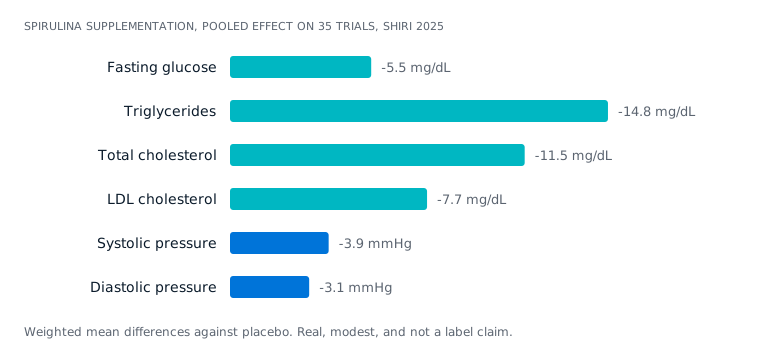
The numbers are real and the effects are modest. Pinto-Leite and colleagues, pooling 9 spirulina trials with stricter inclusion, found a significant but small reduction in diastolic pressure and only a trend on cholesterol, and wrote that the magnitude was of uncertain clinical significance, in their meta-analysis of chlorella and spirulina on cardiovascular risk. On body composition, Kazeminejad and colleagues pooled 61 algae trials and found body weight down 0.8 kg and body fat down 0.9 percentage points, with GRADE ratings of low to very low, in their meta-analysis of algae supplementation and anthropometric indices.
Two more, because they point at the applications supplement brands actually sell. Wei and colleagues pooled 22 exercise trials of algae supplements and found time to exhaustion improved and creatine kinase after exercise reduced, with the effect on muscle damage clearest after resistance work, in their meta-analysis on exercise performance and recovery. And Karimi and colleagues, in a triple blind trial of 80 people with relapsing remitting multiple sclerosis, found 1 g a day of spirulina for 12 weeks lowered serum IL-1 beta and IL-6 and improved physical quality of life scores against placebo, in their randomised trial in multiple sclerosis.
The gap between the biomass and the active
Every trial above used whole spirulina. Phycocyanin is 10 to 20% of that biomass by weight and is the component the authors credit with the antioxidant and anti-inflammatory activity, but a gram of spirulina is not a gram of phycocyanin and the trials do not separate the two. The one human study we found that dosed a titrated phycocyanin liquid, at 1 mg/mL in water polo players, reported better subjective performance scores and was an uncontrolled case series of 20 people, which its own authors say needs a randomised trial, in their case series in water polo players.
So the fair statement is this. The biomass has a body of human evidence with modest, consistent effects on inflammation markers, blood lipids and blood pressure. The purified active is the plausible carrier of that activity and has strong cell and animal data. The human trial on the purified active at a defined dose has not been done at scale, and a supplier who tells you otherwise is selling you the biomass trials with a different label on them.
Why buy the active rather than the biomass, then
Because a capsule is small. A gram of spirulina is a large tablet with a green colour and a taste, and the trials ran at 1 to 6 g. A carrier free phycocyanin at 60% or more delivers the molecule the trials credit at 100 to 500 mg per capsule, in a format a consumer will take. And because the certificate of analysis on a purified active reports the molecule itself, with heavy metals by ICP-MS on the lot, where a biomass certificate reports a powder. What you declare is what you dosed.
What a label can say
In the United States, structure and function only: supports antioxidant defence, helps maintain a healthy inflammatory response. No disease claim, and the blood pressure and cholesterol numbers above are not label claims however many trials sit behind them. In the European Union, spirulina extract is an existing food, no novel food dossier, and there are no authorised health claims for phycocyanin, so the label carries the ingredient and nothing else. Our regulatory line on Phycora says exactly that and it is written so a brand's legal review has nothing to remove.
The dose we run
100 to 500 mg per capsule, direct fill; 5 to 50 mg per gummy into the cool phase before set; 100 to 500 mg in a 3 g stick pack, direct blend; 50 to 300 mg per tablet in direct compression, no heat; 50 to 300 mg per serve in a ready to drink shot above pH 5.5, packed opaque. At 100 to 500 mg per serving, a 10 g sample is 20 to 100 servings, which is a real stability and taste trial rather than a look at the powder.
Sources
According to PubMed:
- Shiri H, Soleimani AA, Omidi Sarajar B, et al. Spirulina's impacts on cardiovascular health: insights from a systematic meta-analysis of RCT. Complement Ther Med, 2025. 10.1016/j.ctim.2025.103242
- Shiri H, Yasbolaghi Sharahi J, Alizadeh Sani M, et al. The effect of spirulina supplementation on blood pressure in adults: a GRADE-assessed systematic review and meta-analysis of randomized clinical trials. Phytother Res, 2025. 10.1002/ptr.8377
- Pinto-Leite M, Martins D, Ferreira AC, et al. The role of chlorella and spirulina as adjuvants of cardiovascular risk factor control: a systematic review and meta-analysis of randomised controlled trials. Nutrients, 2025. 10.3390/nu17060943
- Kazeminejad S, Arzhang P, Baniasadi MM, Hatami A, Azadbakht L. The effect of algae supplementation on anthropometric indices in adults: a GRADE-assessed systematic review and meta-analysis of randomized controlled trials. Nutr Rev, 2025. 10.1093/nutrit/nuae151
- Wei Y, Liu S, You T, et al. The effects of seaweed and microalgae supplementation on exercise performance and recovery: a systematic review and meta-analysis. Nutrients, 2026. 10.3390/nu18081289
- Karimi S, Shaygannejad V, Mohammadalipour A, Feizi A, Hooshmand S, Kafeshani M. Effects of spirulina platensis supplementation on inflammation, physical and mental quality of life, and anthropometric measures in patients with relapsing-remitting multiple sclerosis: a triple-blinded, randomized, placebo-controlled trial. Nutr J, 2025. 10.1186/s12937-025-01200-x
- La Mantia I, Maniaci A, Scibilia G, Scollo P. Effects of a dietary microalgae supplement on stress, well-being, and performance in water polo players: a clinical case series. Nutrients, 2024. 10.3390/nu16152421
The dose table and the regulatory line are from the data sheet for Phycora.
